The Chinese Communist Party Reaches Out — Last Week in the Pacific
Only one of the four missing ambassadors has resumed in-person appearances. In Tonga, Ambassador Liu Weimin reappeared on 15 October at the handover of Dongguan’s assistance package, his first recorded appearance in six weeks. Chargé d’Affaires Cao Yuan had run the embassy’s public engagements through 8 October.
In the Solomon Islands, Ambassador Cai Weiming published op-eds in the Solomon Star and Island Sun on 12 and 22 October but has not appeared at an in-person event tracked by this monitor since 17 September. Chargé Yang Jie chaired the embassy’s quarterly safety meeting with Chinese enterprises on 16 October—a recurring event the ambassador normally hosts.
In Vanuatu, Chargé Gu Zihua met the UN Resident Coordinator on 15 October and led a community visit the next day. Ambassador Li Minggang has had no recorded appearance since 18 September.
The Samoa embassy produced no public activity at all over the past three weeks. The weeks of silence from Samoa and the continued gaps in Honiara and Port Vila remain unexplained.
Summary of PRC Activity
The CCP hosted Pacific political leaders in Beijing and signed a party-to-party memorandum of understanding (MOU) with Papua New Guinea’s ruling Pangu Pati. A new Chinese ambassador arrived in Kiribati, ending a vacancy that began in February. A Guangdong provincial legislature delegation visited Tonga, where Dongguan has held a 10-year sister-city tie with Ha’apai. Port Vila signed a new sister-city agreement with Xi’an. The China-Pacific Island Countries Police Training Center ran a command seminar for Pacific police in Fuzhou.
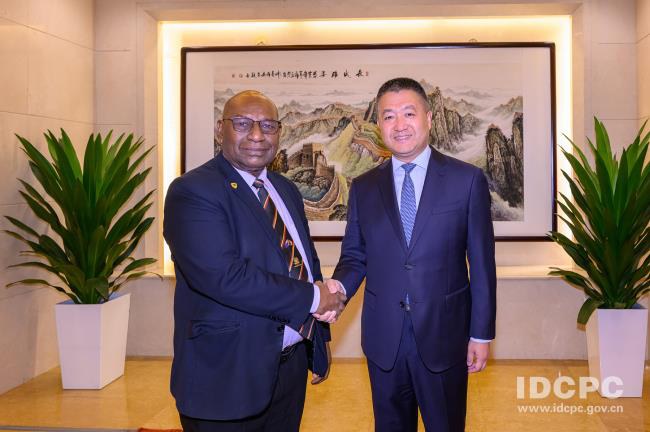
(Source: IDCPC)
This Week’s Big Themes:
Party to Party Ties
On October 10, International Liaison Department (ILD) head Liu Haixing hosted the Sixth China-Pacific Island Countries Political Dialogue in Beijing. Tongan Deputy Prime Minister Viliami Uasike Latu led a Pacific delegation that included representatives from all Pacific Island countries with diplomatic relations with the PRC.
The ILD manages the CCP’s relations with foreign political parties, so the Dialogue primarily draws politicians and party officials rather than government officers. Attendees included PNG Pangu Pati General Secretary Morris Tovebae and former Vanuatu Prime Minister Ishmael Kalsakau, who leads his own party.
Kalsakau used the forum to request aid: marine rescue boats, equipment, and technician training after the MV Matui and Erromango boat disasters. Tovebae used it to request instruction, saying he wanted to learn how China’s party system works.
Liu called for a “political parties plus” approach that casts parties as drivers of closer relations between Pacific countries and the PRC and urged more exchanges of governance experience. Such exchanges recur across China’s Pacific engagement. This monitor has identified four unique interactions between Pacific officials and the ILD this year, including a July ILD delegation to the Solomon Islands that met individually with at least five parties.
The ILD achieved results from the event. Vice Minister Lu Kang and Tovebae signed an MOU establishing relations between the CPC and the Pangu Pati, Prime Minister James Marape’s party. Lu committed the two parties to “exchanges of experience in state governance and administration” and “political parties plus” practical cooperation. Tovebae called the signing “an important historic moment.”
Alongside closure of the Taipei Trade Office in Port Moresby last July, Tovebae sent a letter to all Pangu Pati members reaffirming their adherence to the PRC’s one-China principle.
Prior to the Dialogue, the Pacific delegation met with Wang Yi in his party role as Director of the Office of the Central Foreign Affairs Commission, not as Foreign Minister. Wang pledged to strengthen exchanges between political parties, and the delegates committed to the one-China policy and to closer exchanges with the CCP.
Supporting Events
- Regional: Wang Yi Meets Pacific Political Leaders’ Delegation
- Regional: Sixth China-PIC Political Leadership Dialogue
- Papua New Guinea: CPC and Pangu Pati Sign Inter-Party Relations MOU
- Vanuatu: Kalsakau Requests Maritime Assistance
Kiribati’s New Ambassador
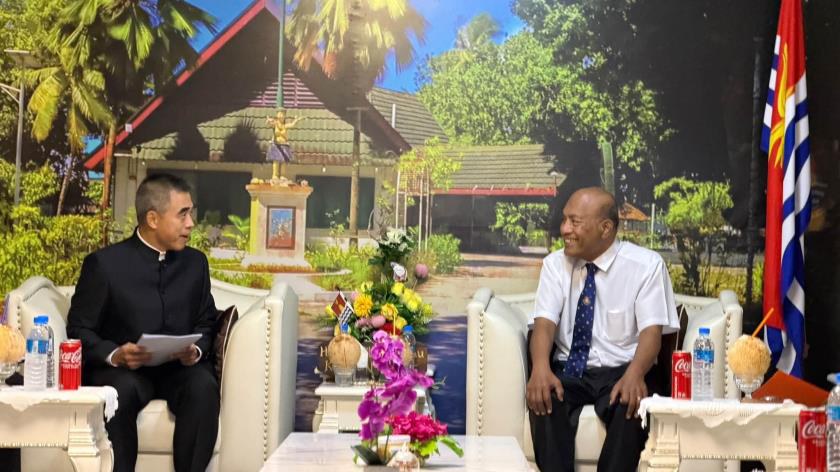
More than eight months after China reassigned Ambassador Zhou Limin from Kiribati to Sweden in early February 2026, Beijing sent a replacement. Ambassador Yao Fei arrived in Tarawa on 16 October. Four cabinet ministers and Foreign Affairs Secretary Tearinaki Tenielu met him at the airport. Six days later, Yao presented his credentials to President Taneti Maamau, who reaffirmed that Kiribati “firmly abides by the one-China policy.” Yao then inspected a Kiribati police guard of honor. Chargé d’Affaires Zhao Jian had run the embassy since Zhou left.
Yao is a career diplomat who most recently served in local government. He was political counselor at China’s embassy in Mexico, then minister-counselor and Chargé d’Affaires in Spain. He later held a minister-counselor-rank post in the Foreign Ministry’s Department of European Affairs. From October 2023 to November 2025, he served as vice mayor of Quanzhou, Fujian.
Yao’s time in local government is not unusual for Chinese diplomats: Zhou Limin also served two years as a mayor in Hebei Province before becoming a Deputy Director in the Ministry of Foreign Affairs and then ambassador to Kiribati. Such assignments probably serve as both a holding place between foreign postings and a test of administrative acumen. Quanzhou sits in Fujian, a province active in subnational diplomacy with the Pacific. In the past three weeks, Fujian institutions hosted three Pacific programs:
- A public affairs course for a Solomon Islands cohort at the Fujian International Economic Cooperation Center
- A juncao course for Kosrae participants at Fujian Agriculture and Forestry University
- A police command seminar for Kiribati officers at Fujian Police College
Supporting Events
- Kiribati: New Ambassador Yao Fei Arrives in Tarawa
- Kiribati: Yao Fei Presents Credentials to President Maamau
Provinces and Sister Cities
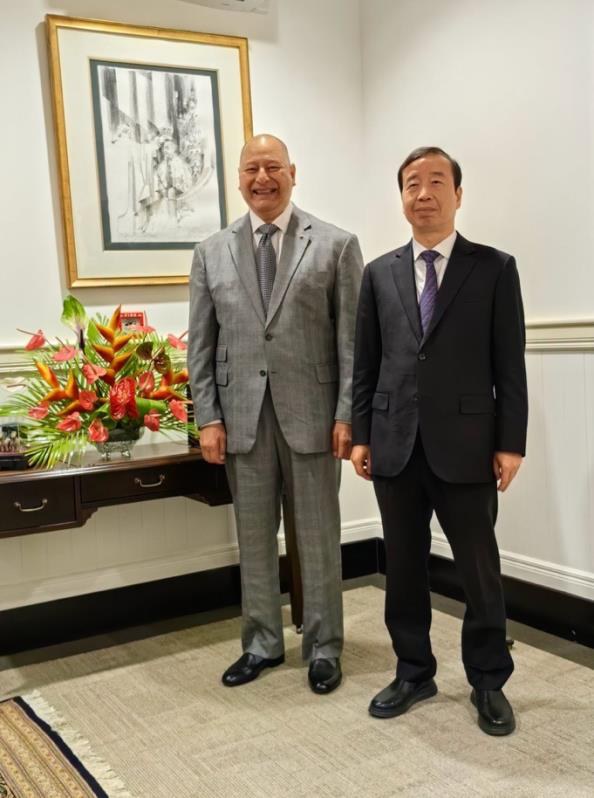
From 14 to 17 October, a joint Guangdong–Dongguan delegation visited Tonga, building on ten years of Dongguan-Ha’apai sister city ties. Xiao Yafei, Vice Chairperson of the Standing Committee of the Guangdong Provincial People’s Congress, led the Chinese side. Xiao is a former mayor and deputy party secretary of Dongguan. He was accompanied by Yang Xiaotang, the Deputy Director of the Standing Committee of the Dongguan Municipal People’s Congress. In Ha’apai, Governor Pita Taufatofua hosted a welcome ceremony where the delegation handed over outboard engines and a sister-city scholarship.
Meeting with HRH Princess Pilolevu, the head of the Tonga-China Friendship Association (TCFA), and in partnership with TCFA, the delegation handed out schoolbags to students at the Queen Sālote College where Dongguan is funding the construction of an auditorium. Prime Minister Lord Fakafanua, Ambassador Liu Weimin, and Xiao Yafei witnessed the handover of a material and financial assistance package from Dongguan. The aid comprises household solar systems, tractors, a garbage truck, outboard engines, sports equipment, and school and community renovations.
In a meeting with the Tongan Legislative Assembly, the delegation discussed coastal-protection legislation and regulatory governance, which builds on Lord Speaker Vaea’s visit to Guangdong last May. The delegation capped the week off with an audience with King Tupou VI and discussed multi-sector subnational diplomacy.
Beyond Tonga, Port Vila Lord Mayor Samuel Iani signed a sister-city agreement with Liaocheng, Shandong, at the China International Friendship Cities Conference in Xi’an on 20 October. Liaocheng’s government, university, and vocational college have appeared in this monitor’s records before.
On 21 October, Guangdong Rising Holdings signed an agreement with the PNG government to advance the Sepik Integrated Development Project. The company is the subsidiary of a Guangdong provincial state-owned enterprise—State-Owned Assets Supervision and Administration Commission of Guangdong Province (SASAC)—and controls the Frieda River copper-gold project through its own subsidiary PanAust. The project joins the mine with a hydroelectric facility. He Yu, a deputy director of the provincial SASAC, led the Chinese delegation for the signing. Prime Minister Marape and five cabinet ministers witnessed the signing alongside five cabinet ministers. Marape also set up a state negotiating team ahead of his November trip to APEC in Shenzhen.
Supporting Events
- Tonga: Ha’apai Marks Ten Years of Dongguan Sister-City Ties
- Tonga: Guangdong–Dongguan Delegation Meets Princess Pilolevu
- Tonga: Dongguan Funds Queen Sālote College Auditorium
- Tonga: PM Fakafanua Witnesses Dongguan Assistance Handover
- Tonga: Guangdong People’s Congress Meets Legislative Assembly
- Tonga: King Tupou VI Receives Guangdong Delegation
- Vanuatu: Port Vila Signs Sister-City Agreement with Liaocheng
- Papua New Guinea: Guangdong Rising Signs Frieda River Joint Understanding
* The PRC Pacific Embassies Monitor provides systematic, open-source tracking of Beijing’s public diplomatic activities across the nine Pacific Island Countries hosting Chinese missions. The monitor captures official embassy social media and website posts, supplemented by local sources, to offer a weekly structured intelligence report that bridges critical information gaps on regional engagement.