
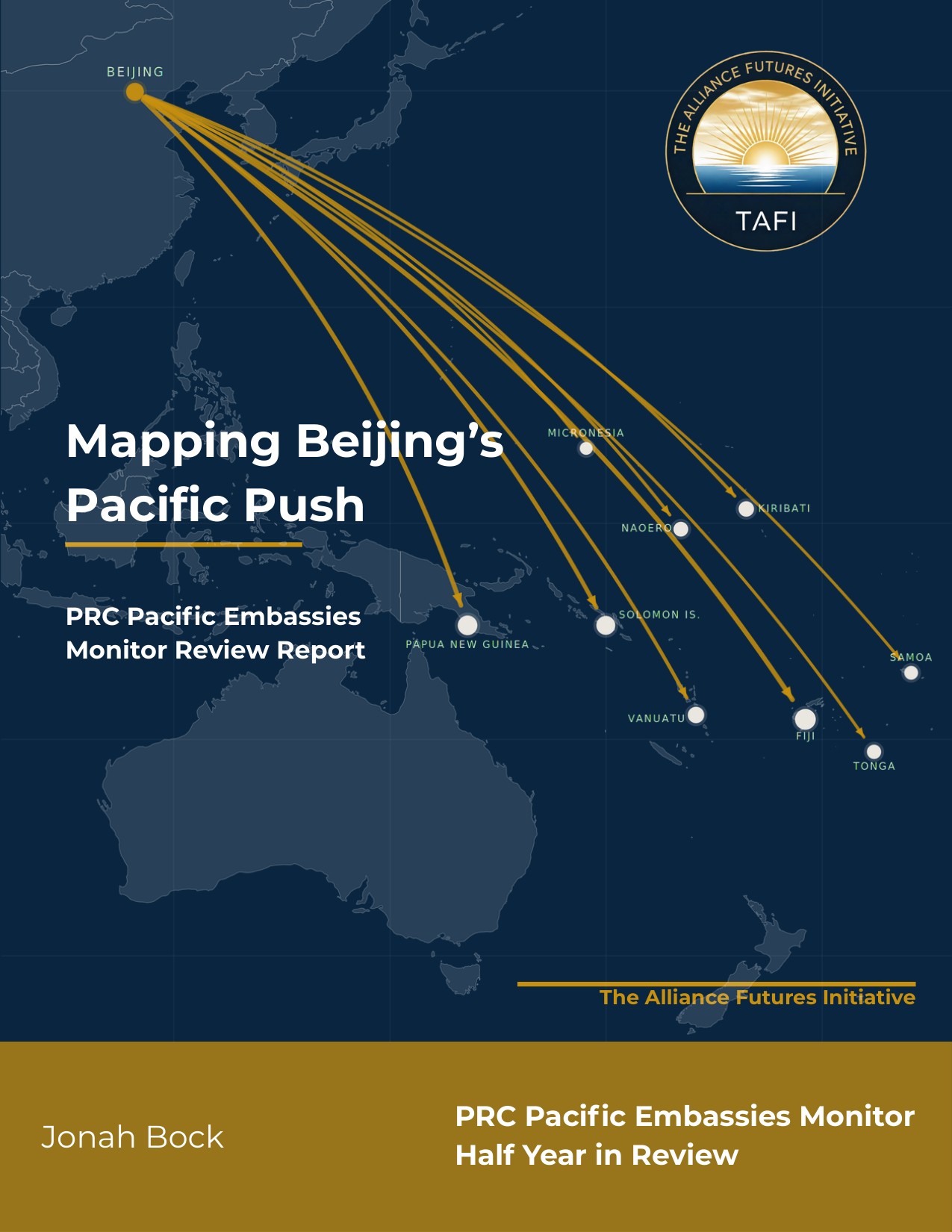
Mapping Beijing’s Pacific Push: PRC Pacific Embassies Monitor Half-Year in Review
Seven months of systematic open-source collection across the nine Pacific Island Countries hosting permanent Chinese missions, from 1 December 2025 to 30 June 2026.
Executive Summary and Key Findings
The Alliance Futures Initiative’s PRC Pacific Embassies Monitor (PPEM) is an open-source intelligence collection and analysis project covering the online activity of China’s embassies in the Pacific Islands region. The project systematically records publicized activity, structuring it to allow for cross-country and temporal analysis.
The PRC Pacific Embassies Monitor captures activity conducted by any government, academic, corporate, and other representatives from China and Chinese institutions. Most, but not all, events feature the Chinese embassies themselves. Because the Monitor only captures open-source activity, it is first and foremost a tool for understanding how China portrays itself and how host countries portray Chinese diplomatic activities.
Key findings for the first seven months of data collection include:
- Event postings dropped sharply at the beginning of 2026, recovered through winter and early spring, and rose steeply in May and June 2026. Activity in Kiribati and the Solomon Islands drove most, but not all, of this trend.
- The Solomon Islands and Tonga generated the most recorded events. Samoa, Papua New Guinea, and the Federated States of Micronesia generated the fewest.
- The departure of the Chinese Ambassador to Kiribati caused a sharp drop in online activity, reflecting both the Ambassador’s centrality to the post and the embassy’s preference for publicizing ambassadorial over other activities.
- Only the Solomon Islands and Tonga Embassies show a meaningful volume of publicized activity by counselor-rank personnel.
- The Solomon Islands embassy posts the highest proportion of development activity, driven by programs and projects that produce frequent, systematized events.
Introduction
Since 1 December, 2025, The Alliance Futures Initiative has systematically collected Chinese diplomatic and public activity in the nine Pacific Island Countries hosting permanent Chinese missions: the Federated States of Micronesia (FSM), Fiji, Kiribati, Naoero (Nauru), Papua New Guinea (PNG), Samoa, the Solomon Islands, Tonga, and Vanuatu. This report covers data from 1 December 2025 to 30 June 2026.
The PRC Pacific Embassies Monitor draws primarily on the embassies’ own social media posts and official websites, supplemented by host-country social media pages and local media outlets. Some events go unrecorded, but daily tracking across these sources produces a reliable picture of publicized Chinese activity in the Pacific Islands.
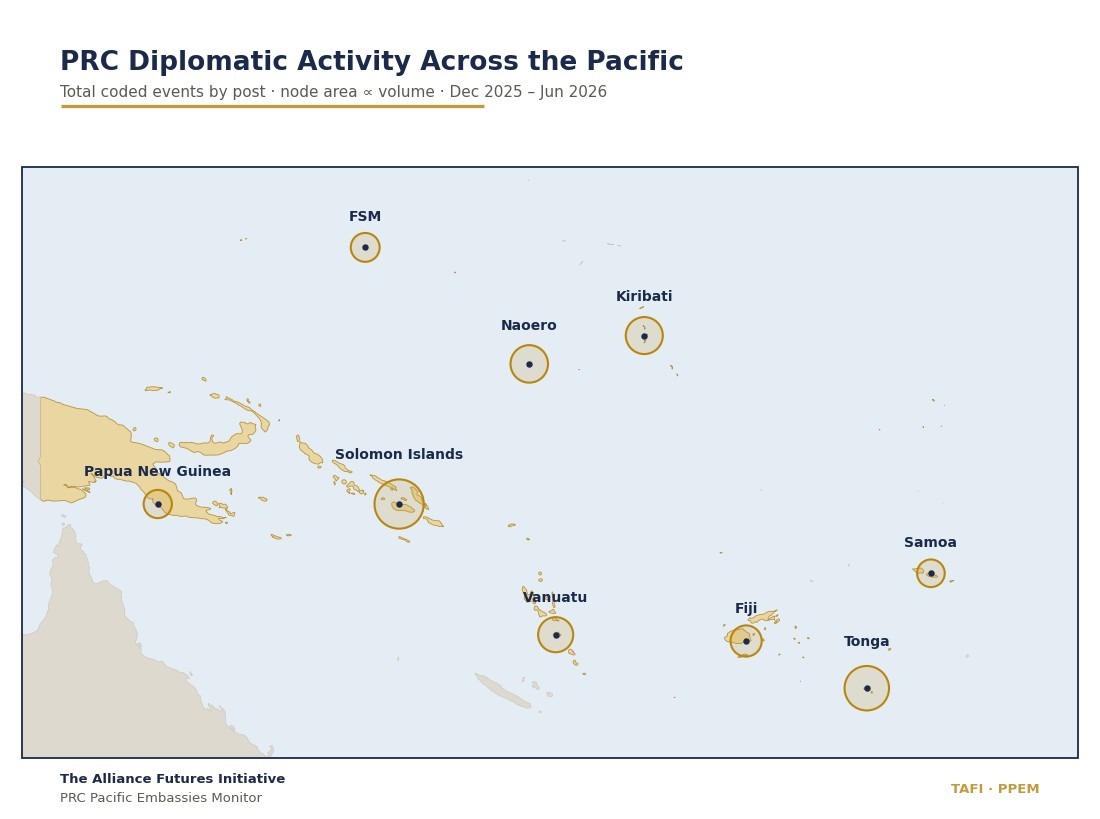
China’s embassies post with notable transparency. Their public activity serves two audiences: their host countries and the Ministry of Foreign Affairs in Beijing. Any diplomatic mission’s central task is to improve public perceptions of the sending country. Without an online presence, a bicycle donation reaches only the students who receive it, their parents, and their immediate community. With one, the visibility extends across ocean distances to audiences with no direct connection to the event. China’s ambassadors are also closely watched by Beijing. In China’s Leninist party-state, cadres advance based on party loyalty, ideological reliability, and bureaucratic connections—not merit alone.
As part of this project, TAFI produces weekly reports on select events and themes. These reports are available on TAFI’s Substack and website. TAFI also produces research derived from the monitor. The monitor’s identification of a Chinese telecommunications firm operating in the Pacific led to investigative research on the company’s practices and the threats it may pose to regional and US security.
Definitions and coding categories discussed throughout this report are available upon request.
Overview
Methodology
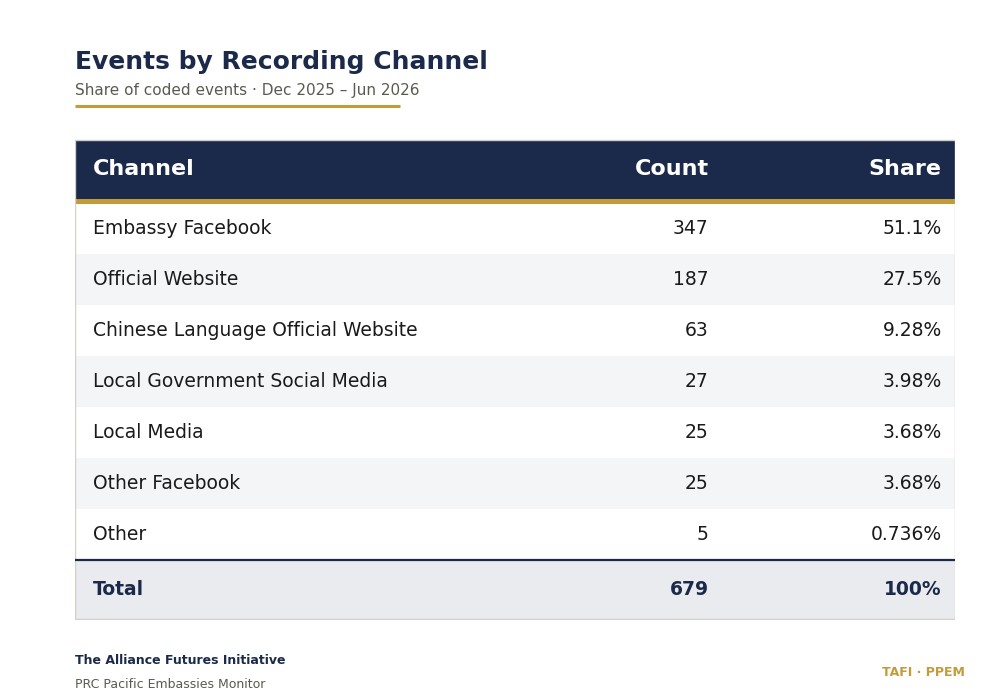
The PRC Pacific Embassies Monitor has several key limitations. It draws primarily on information from the embassies themselves or host governments—information filtered through the institutional interests of those publishers. The monitor mitigates this filtering by triangulating across the widest possible range of sources, but the embassies remain the dominant source. The number of events from each source follow in the table below:
The monitor produces a useful overview of Chinese activity in the Pacific but cannot claim comprehensiveness. The data does not always support definitive statistical conclusions. This collection period logged only 45 activities for PNG, a sample too small for reliable quantitative analysis. At low event counts, single clusters distort the apparent distribution. A Guangdong-focused delegation led by PNG Prime Minister James Marape in late April registers in the data as a spike in commercial diplomacy that month—but the spike reflects the delegation itself, not necessarily a shift in Chinese strategy or sustained attention to the topic. Similar explanations apply to other patterns in the data, as the country sections below detail. This report uses data visualizations as a guide to qualitative insights rather than as a basis for statistical inference.
Publishers filter the activity, but photographs often contain information the text omits. China’s Ambassador to Naoero, Lyu Jin, held a meeting with Naoero’s Media Bureau that resulted in a Wang Yi speech airing on Naoeroan state television. Unmentioned in the text, but visible in the photographs, is a novelty-sized check made out to the Naoeroan government, sitting in the background.
Top-Level Trends
Monthly Variance in Event Totals
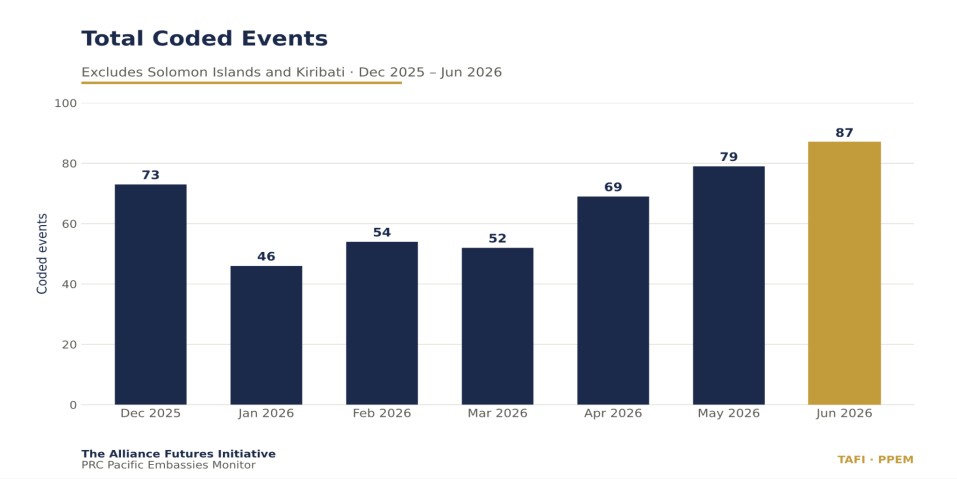
The headline trend for the monitor is a drop in event frequency at the start of 2026, a recovery through winter and early spring, and a steep rise in May and June.
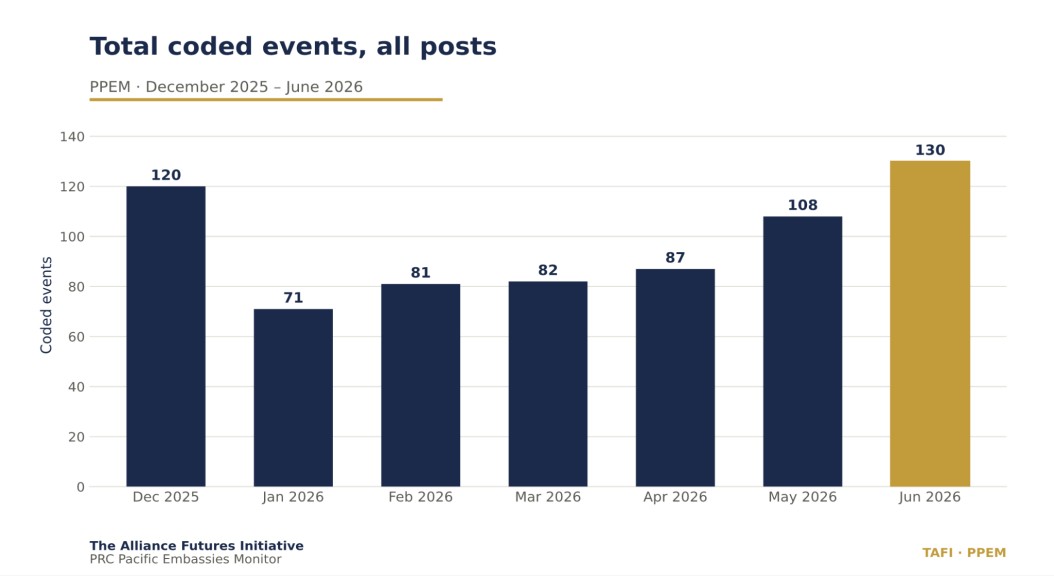
December 2025, the first month of collection, logged 120 events—a figure that fell 40 percent in January. February edged up slightly, but 16 Lunar New Year events—embassy receptions and ‘warmth package’ distributions to the diaspora—drove most of that recovery. The December-to-January drop appears across all posts, though to varying degrees. Samoa, which runs consistently low, lost only one event, too few to carry analytical weight.
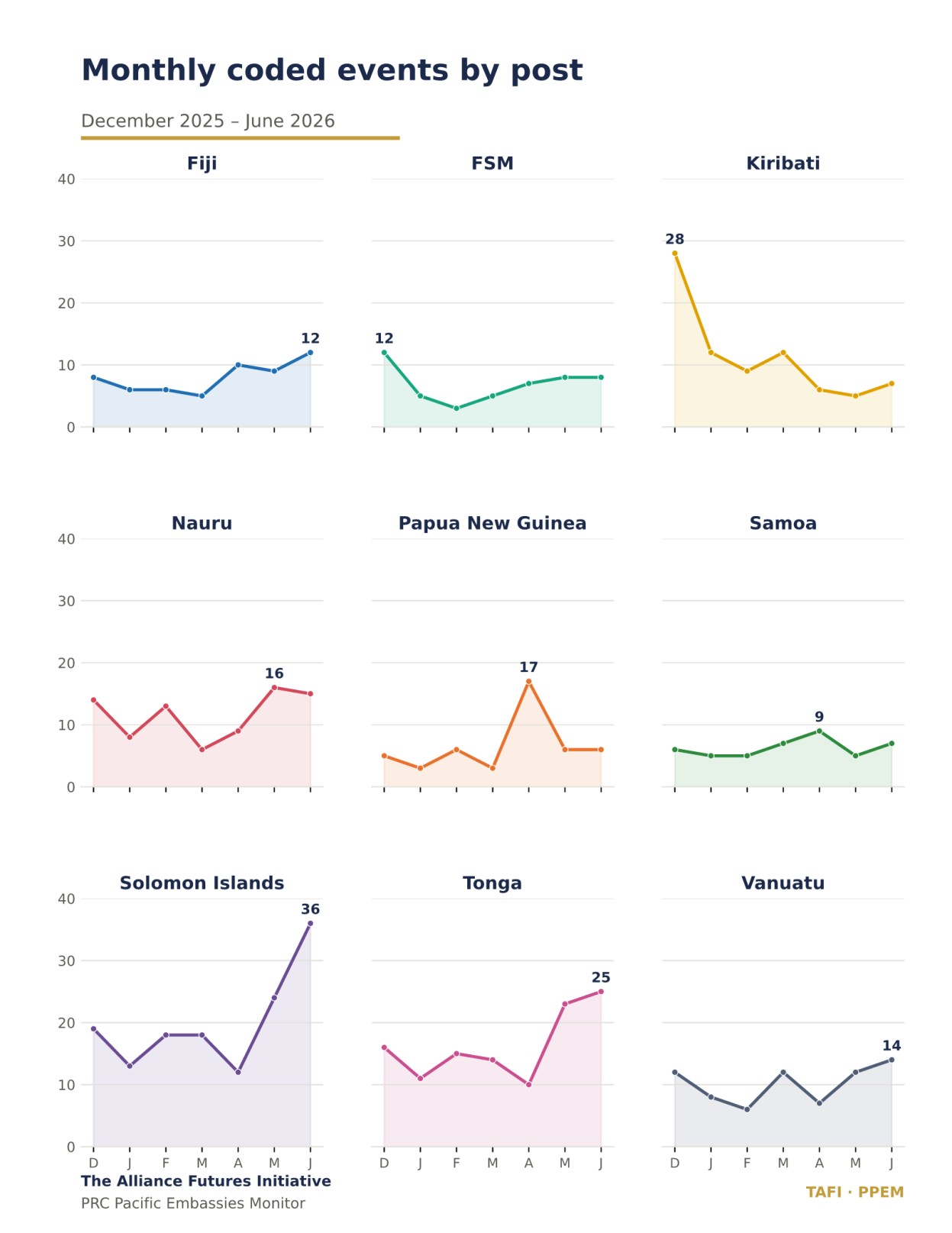
The depth of the drop reflects a sharp fall in Kiribati’s publicized activity. From December to February, Kiribati tracking fell from 28 to 9 events, 48 percent of the total decrease. Ambassador Zhou Limin’s departure in early February drove this fall. In the month before his departure, much of the embassy’s activity consisted of farewell meetings. Beijing has not filled the post since, and Kiribati’s activity has stayed subdued relative to December levels and to other embassies across the year.
The May and June 2026 increase holds across all posts, but several factors explain it. The Solomon Islands accounted for 56 percent of the April-to-June rise, a period coinciding with the change of government and Matthew Wale’s election as Prime Minister. The PRC Embassy’s courtesy calls with new ministers across May and June account for 20 percent of the April-to-June increase; a Jiangsu Province delegation accounts for a similar share. No single activity type or functional domain drove the rise disproportionately—the pattern was broad and consistent.
The increase should not be read simply as more activity. The Wale government has tilted its partnerships away from China and toward Australia. The PRC Embassy may be publicizing more than usual to signal its continued relevance to the new administration. Figure 4 shows the total events excluding the Solomon Islands and Kiribati. Figure 5 shows the number of events per month across every individual posting.
Total Event Distribution by Country
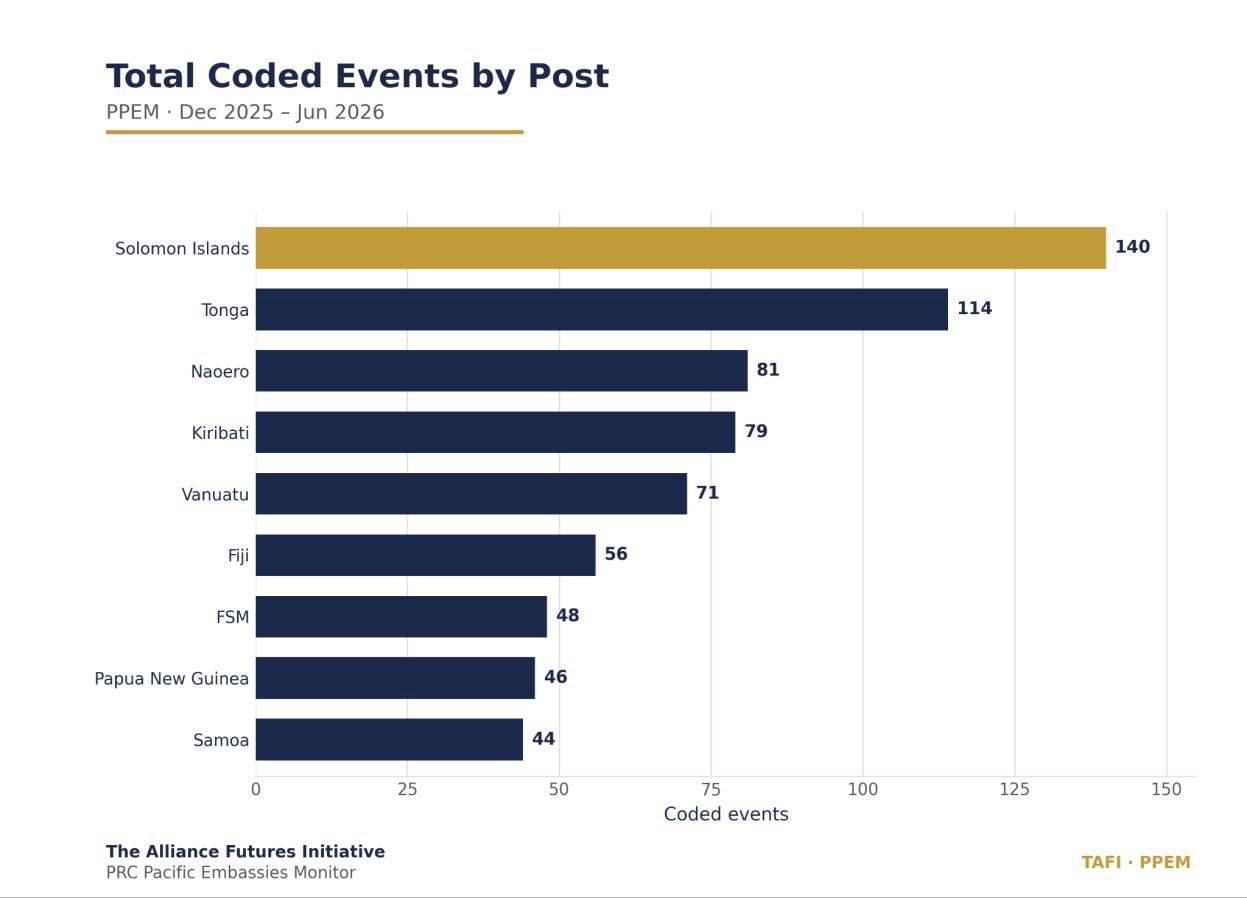
The Solomon Islands and Tonga dominate the database, accounting for 21 percent and 16 percent of all recorded events respectively. Samoa, Papua New Guinea, and the Federated States of Micronesia generated the fewest, each at roughly 6.5 percent. The full distribution appears in the figure below.
Functional Domain by Country
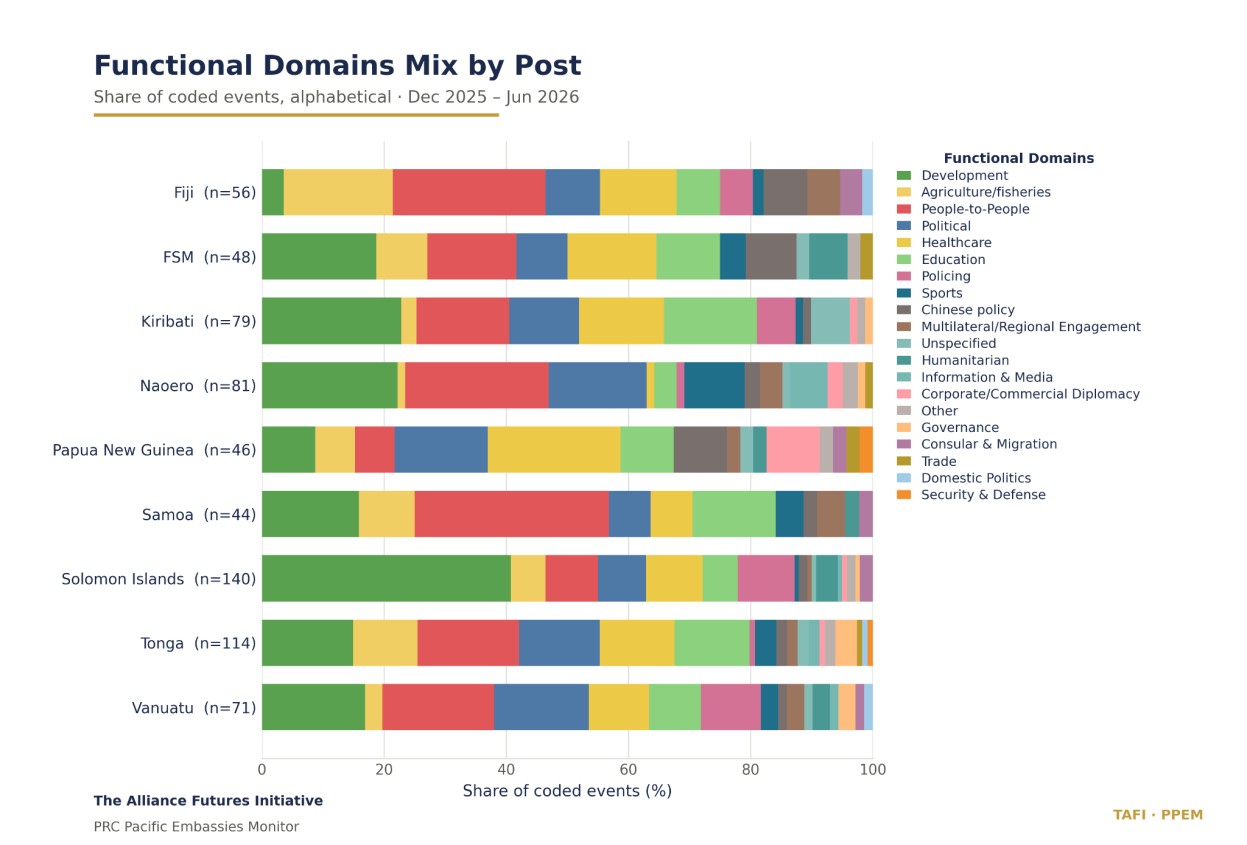
The remainder of this report surveys the monitor’s data by functional domain and activity type. The functional domain captures what an activity was about. Some categories rest on physical facts: an event involving healthcare provision or medical supplies is coded “healthcare”; one involving police is coded “policing.” Categories such as “political”—which covers the bilateral relationship and relevant foreign policy positions—are coded based on framing.
Across posts, “development” and “people-to-people” activities consistently lead the domain mix, with exceptions. This distribution reflects the embassies’ actual activities and their publishing choices in roughly equal measure. China conducts substantial development work, but development activity is also the kind most likely to reinforce the image of China as a generous partner—the primary purpose of any embassy’s online presence. Events that cast China favorably, dominate the functional domain type mix. Many posted meetings include a photograph and a brief write-up on discussion topics, usually vague.
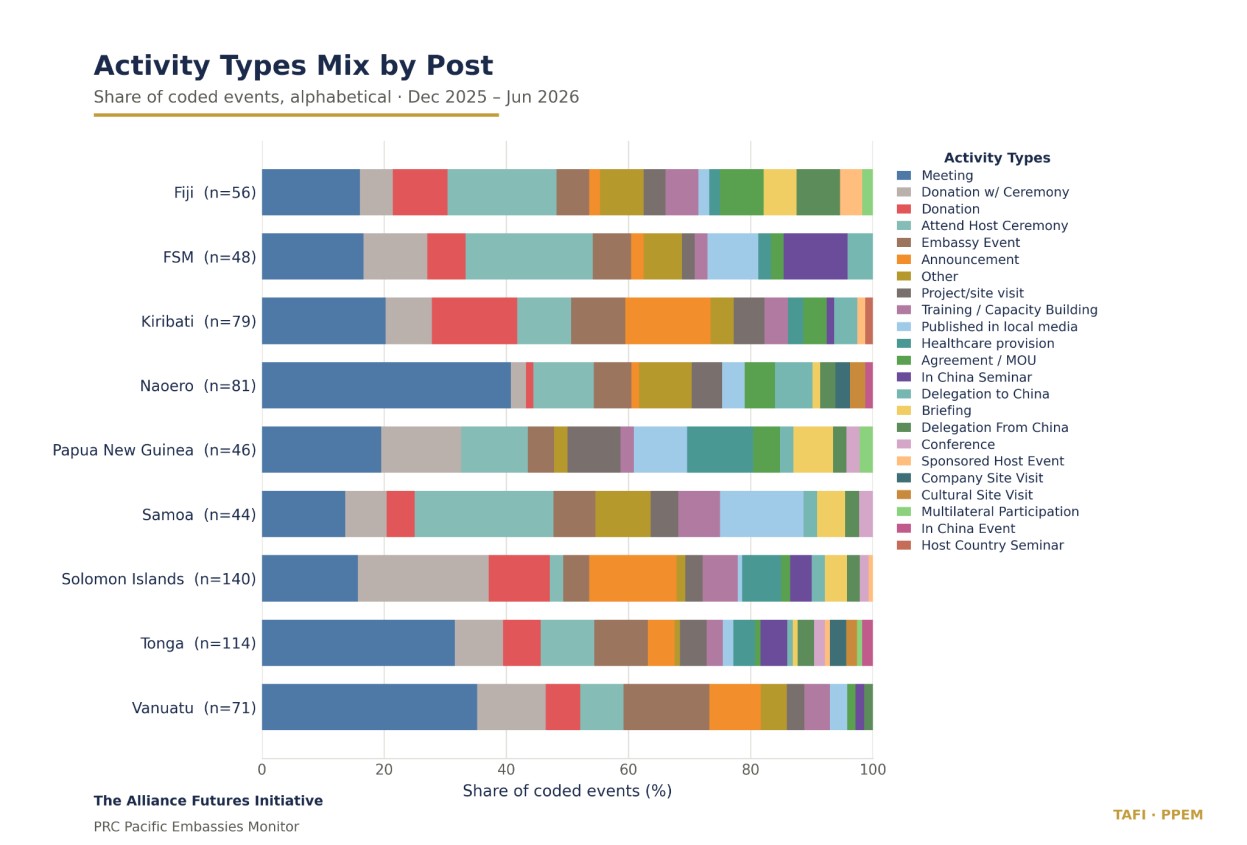
Activity Type by Post
Activity type captures how an event was carried out rather than the activity theme or topic. The monitor records only events that reflect something that actually happened and bears on the bilateral or regional relationship—posts celebrating Chinese culture or reporting on meetings between heads of state outside the Pacific are excluded. An embassy’s reporting style shapes the data as much as its actual activities. Events that are easy to publicize or that cast China as a generous partner dominate the activity type mix. Many recorded meetings consist of a photograph of the parties and a brief write-up on discussion topics, usually vague. Donations require more logistical coordination but generate strong public imagery for China and appear frequently as a result. A high proportion of meetings or donations still carries information about how an embassy operates, but any conclusions must account for the source’s role in filtering what gets published.
Country Breakdowns
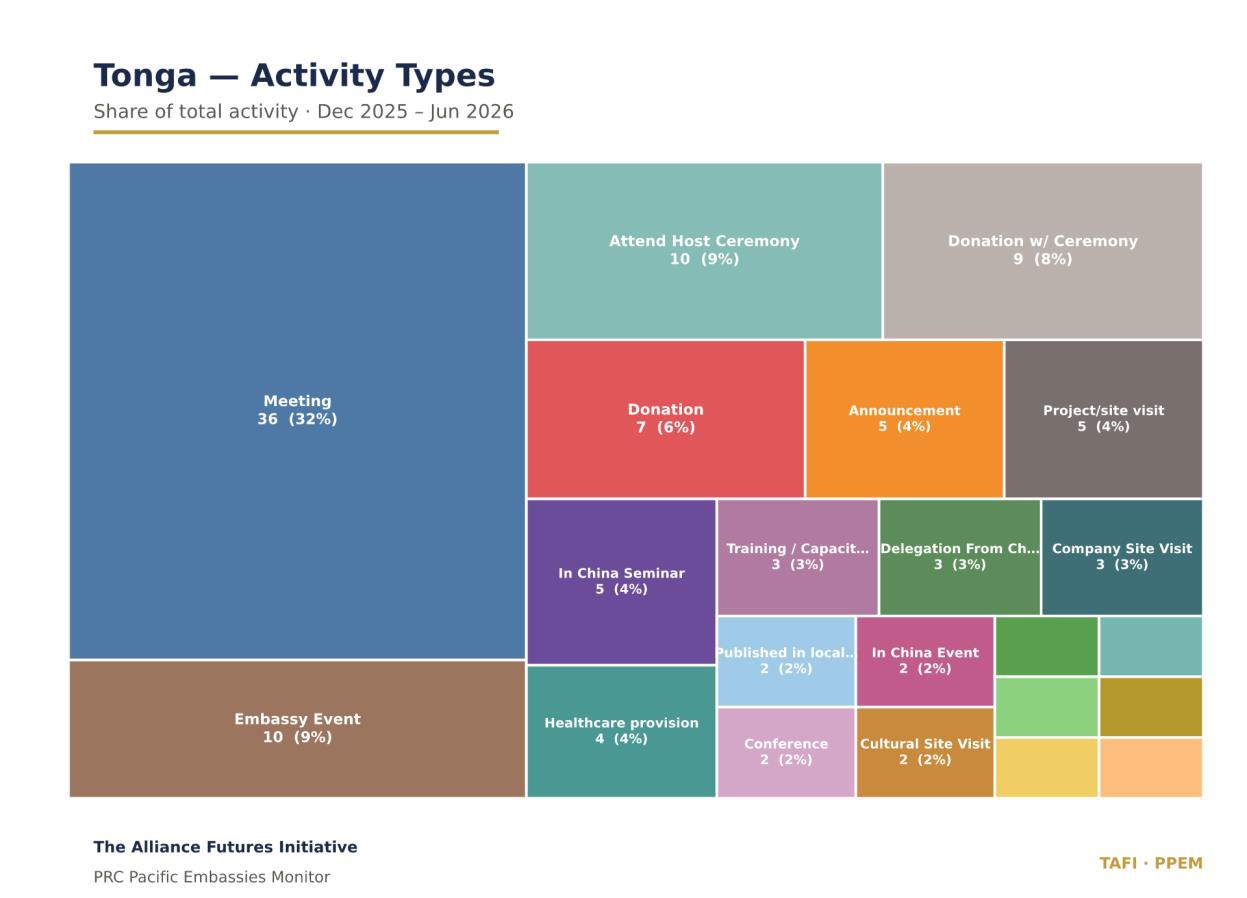
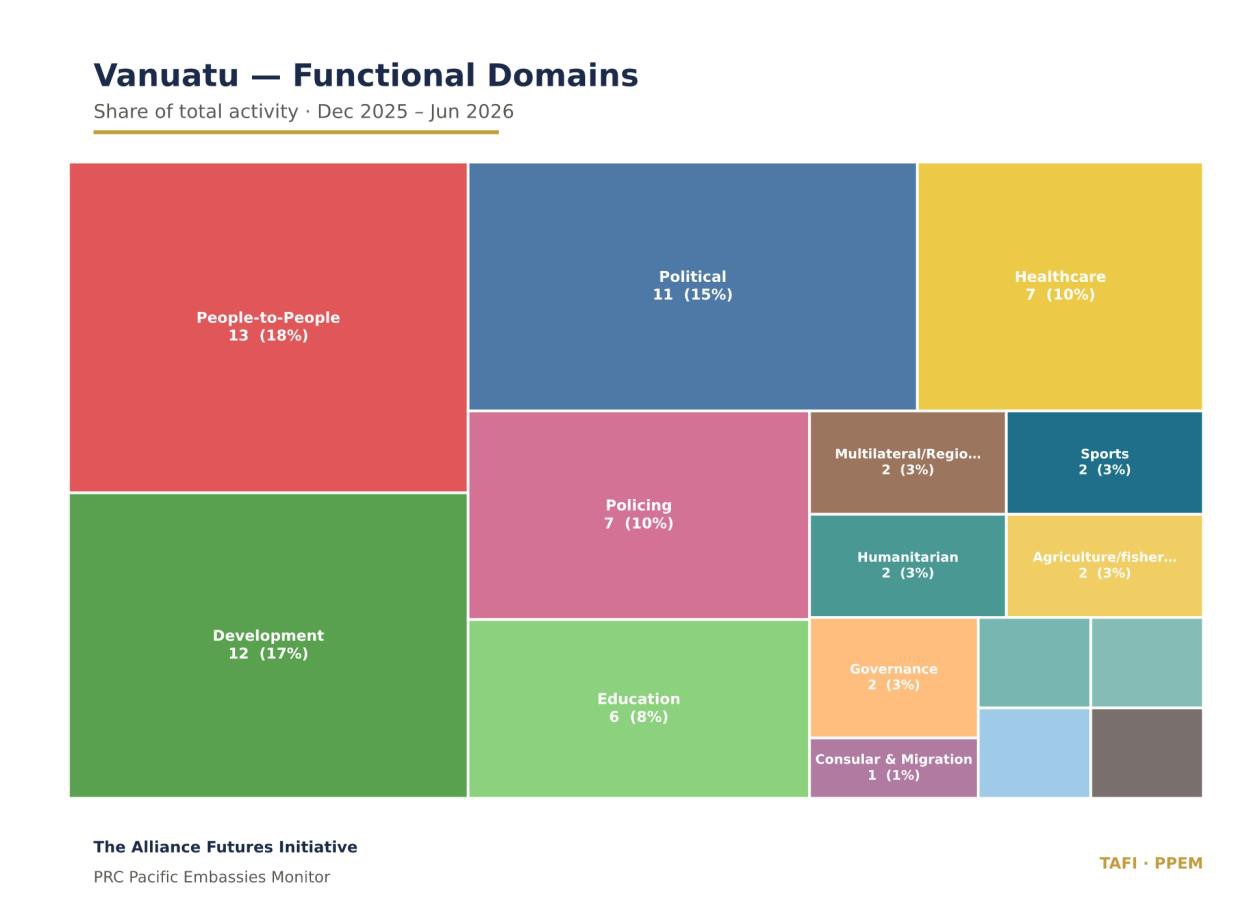
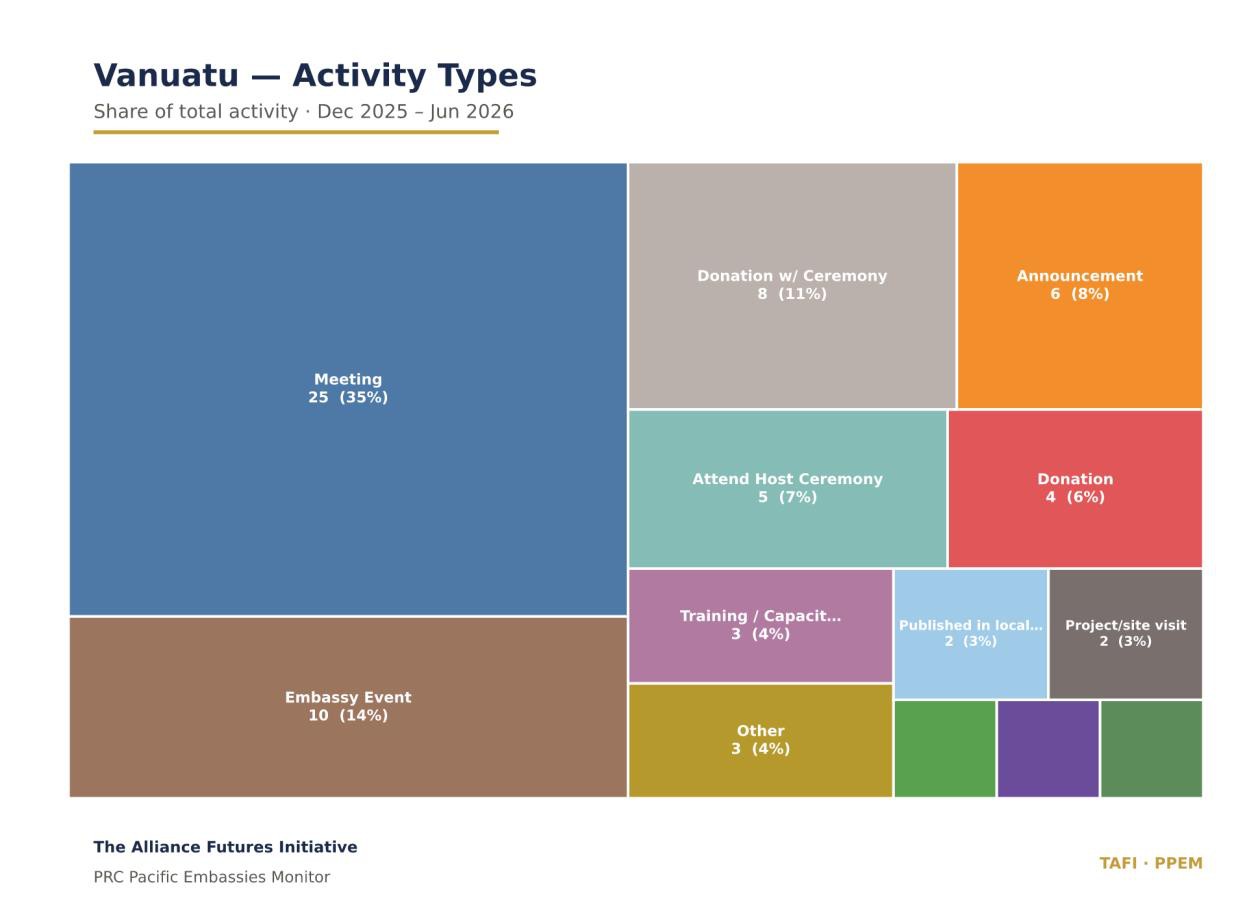
The sections below profile each of the nine Chinese missions in the Pacific Islands. Tree map charts display the functional domain and activity type distributions for each post. Accompanying text explains distinctive patterns in the data and draws out analytical observations from the events themselves.
Federated States of Micronesia
Functional Domain
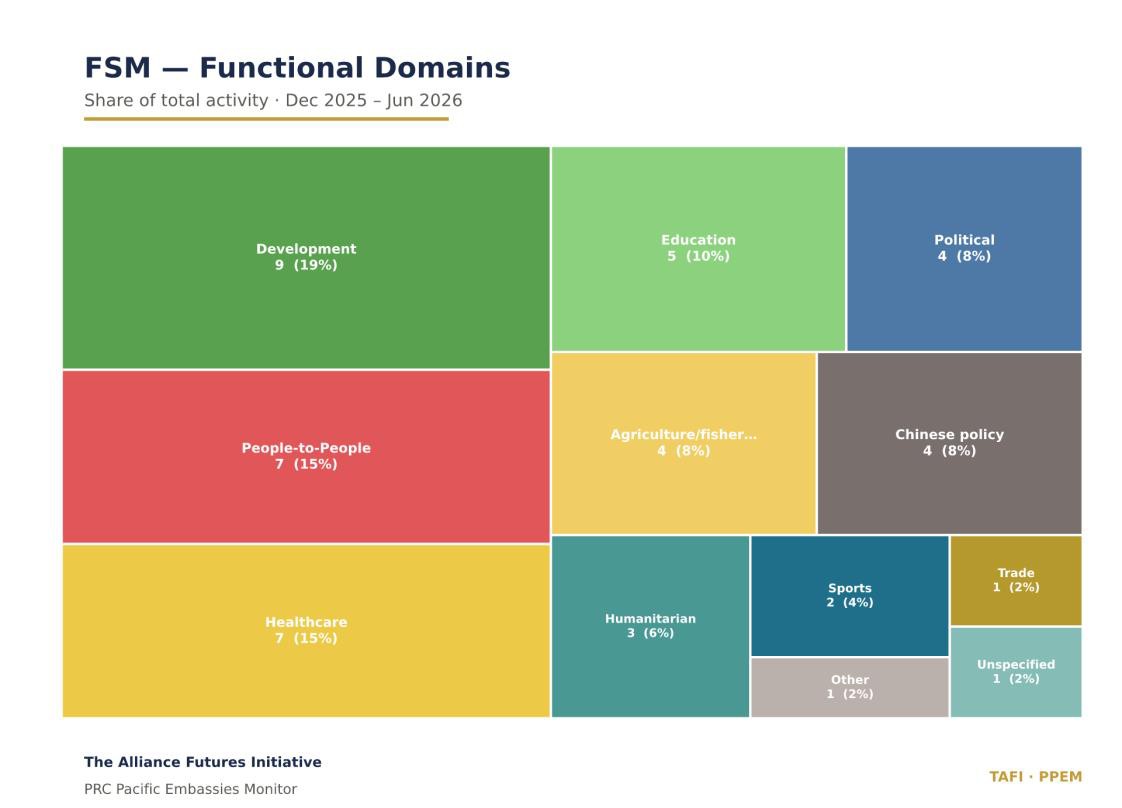
The FSM embassy’s publicized activity distributes across three roughly equal domains: development, people-to-people, and healthcare. Development falls into two categories: large-scale infrastructure projects and China-hosted seminars. Infrastructure work during the collection period included a Minutes of Discussion on a road upgrade feasibility study in Yap State, an implementation agreement for road rehabilitation in Chuuk and bridge reconstruction in Pohnpei, and a groundbreaking for a bridge in Kosrae under an Asian Development Bank (ADB) funded grant. This infrastructure activity spread across all four FSM states, an unusual degree of geographic distribution for a single post. One representative seminar sent FSM officials to China for training on property management and maintenance of aid projects in the South Pacific.
Healthcare events in FSM drew from a range of actors: a meeting with the Health Minister, a meeting with the WHO representative for Northern Micronesia, attendance at a disaster-relief health partners meeting in Chuuk State, and a medical supplies donation, among others.
Activity Type
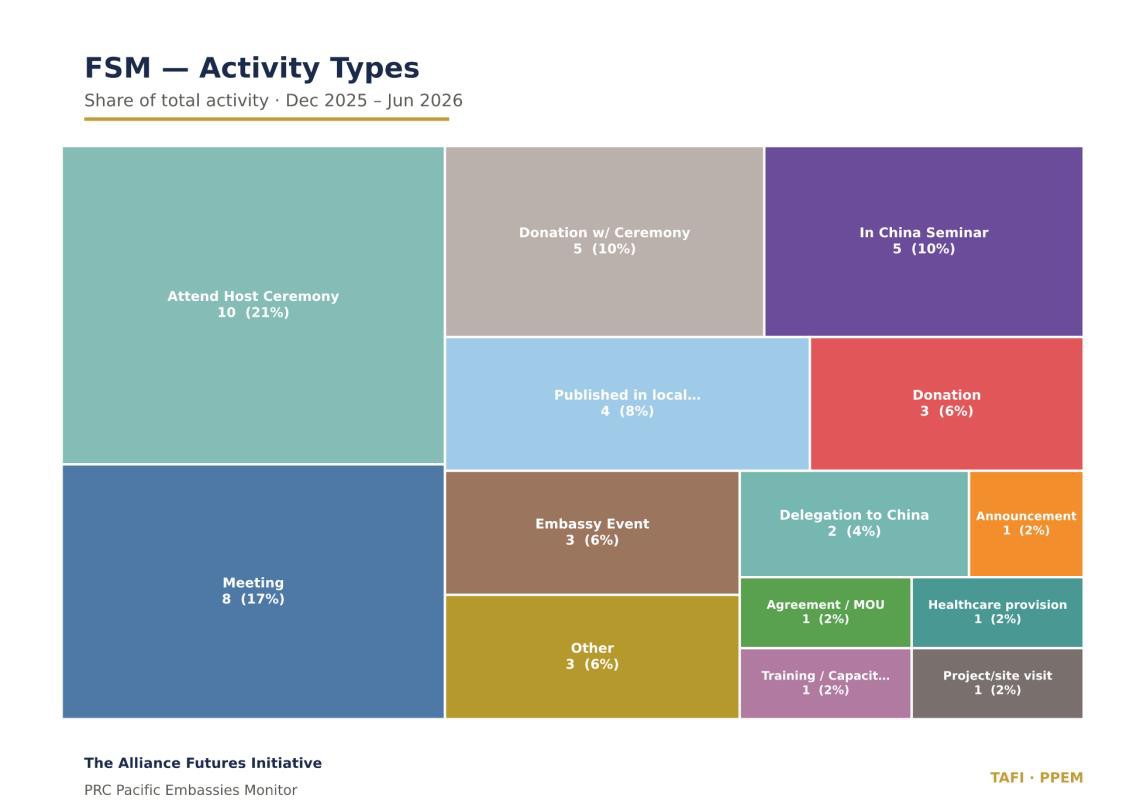
FSM’s high people-to-people share produces a correspondingly high rate of embassy staff attending host ceremonies. FSM is one of three posts—along with the Solomon Islands and Tonga—where officials traveled to China for seminars in notable numbers. Three of eight recorded meetings addressed political topics, edging above the average across posts, a proportion that most likely reflects the small total event count rather than elevated political engagement.
Fiji
Functional Domain
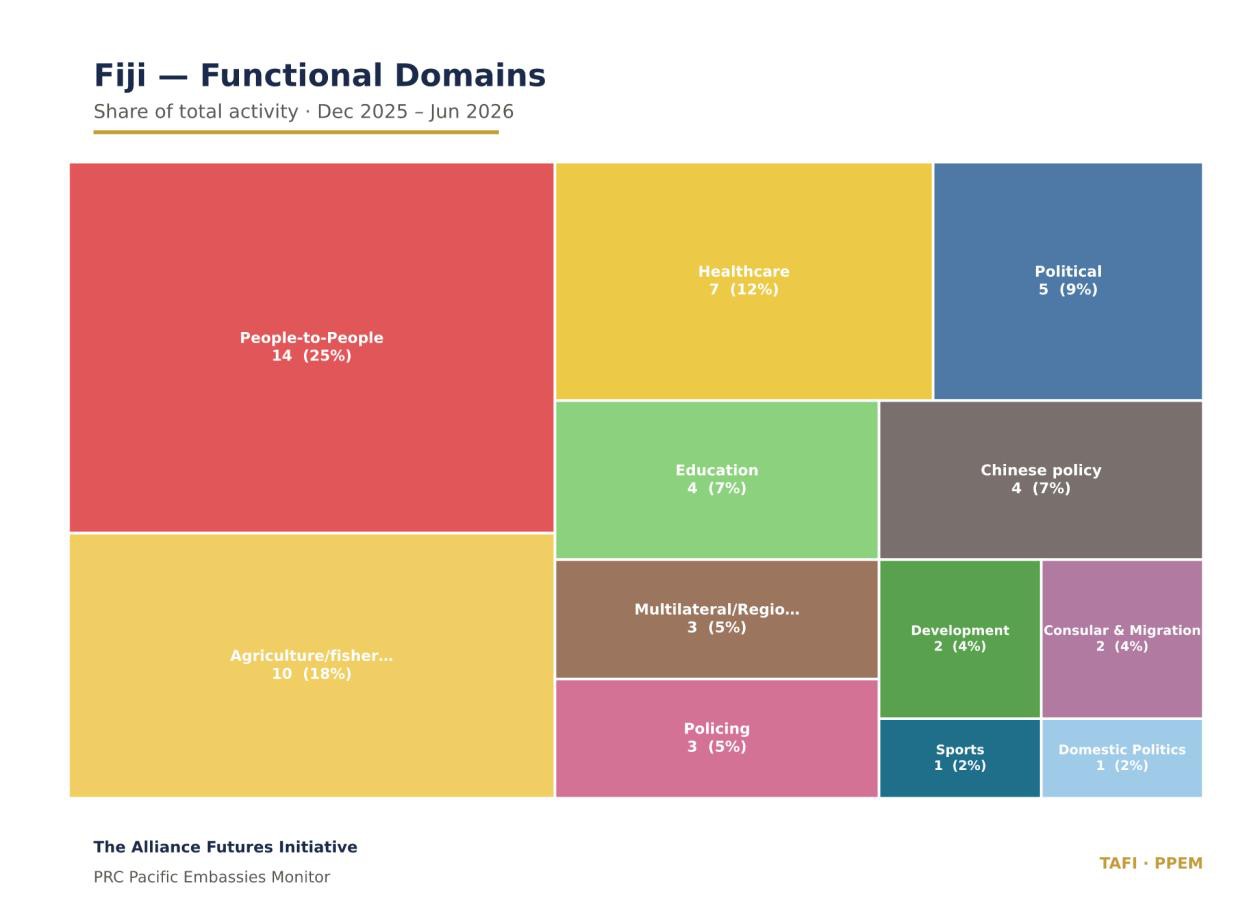
Fiji’s data stands out for its agricultural and fisheries share: 18 percent of recorded events, three times the average across posts. The activity splits into two threads—juncao and rice—each with Chinese teams present in the country. Agricultural assistance here offers a clear window into how China’s subnational and multilateral diplomacy reinforce each other.
Juncao is a Chinese-developed, grass-based technology for mushroom cultivation, ecological management, and livestock feed. One of China’s seven dedicated Pacific Islands multilateral platforms focuses on juncao alone; its implementing body, the China–Pacific Island Countries Juncao Technology Demonstration Center, operates out of Nadi and trains counterparts from across the region. Fiji also hosts the China-Fiji Agricultural Cooperation Project—the China Rice Team—which maintains an active demonstration field in the country.
A June delegation from Jiangsu Province introduced a second China-Pacific Island Countries (PICs) platform to Fiji: the China–Pacific Island Countries Agriculture Cooperation and Demonstration Center, administered by the Jiangsu Academy of Agricultural Sciences, opened a new project during the visit.
Activity Type
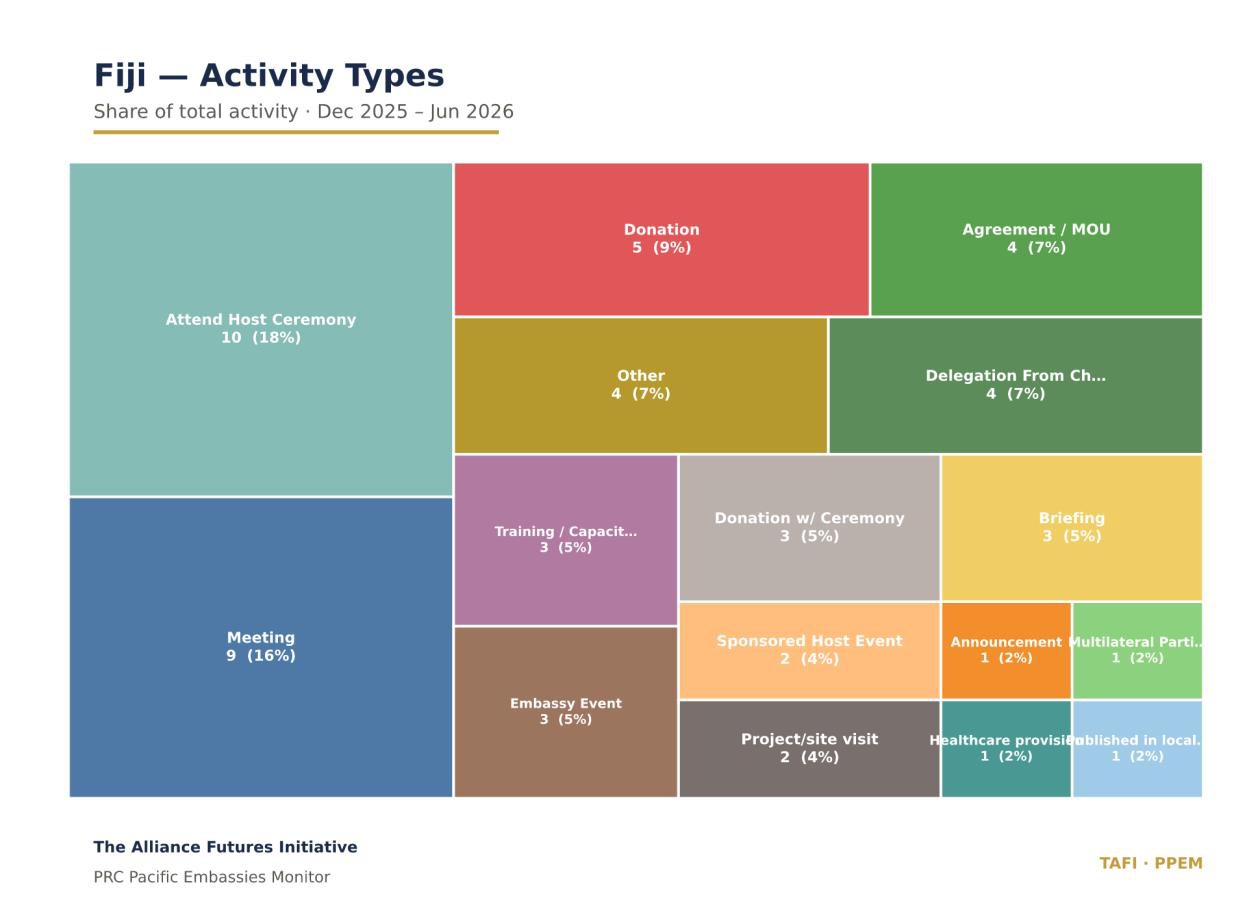
Fiji records a high number of embassy staff attending host ceremonies, but many of those events originated with overseas Chinese communities or China-affiliated institutions, such as the Chinese Association of Fiji and the Chinese Cultural Center in Fiji.
Fiji also received more visiting delegations from China than most posts. Three delegations traveled onward to other Pacific Island countries: the GX Foundation and the Southern University of Science and Technology (SUSTech) continued to Tonga; the Jiangsu Province delegation traveled to the Solomon Islands after Fiji. The GX Foundation is a Hong Kong-based nonprofit providing medical and humanitarian assistance to Belt and Road countries. Its chairman, Leung Chun-ying, serves as Vice-Chairman of the National Committee of the Chinese People’s Political Consultative Conference, a direct link to the PRC party-state. Fiji alone received a delegation from China’s Ministry of Agriculture and Rural Affairs for a ministerial-level meeting on juncao technology.
Kiribati
Functional Domain
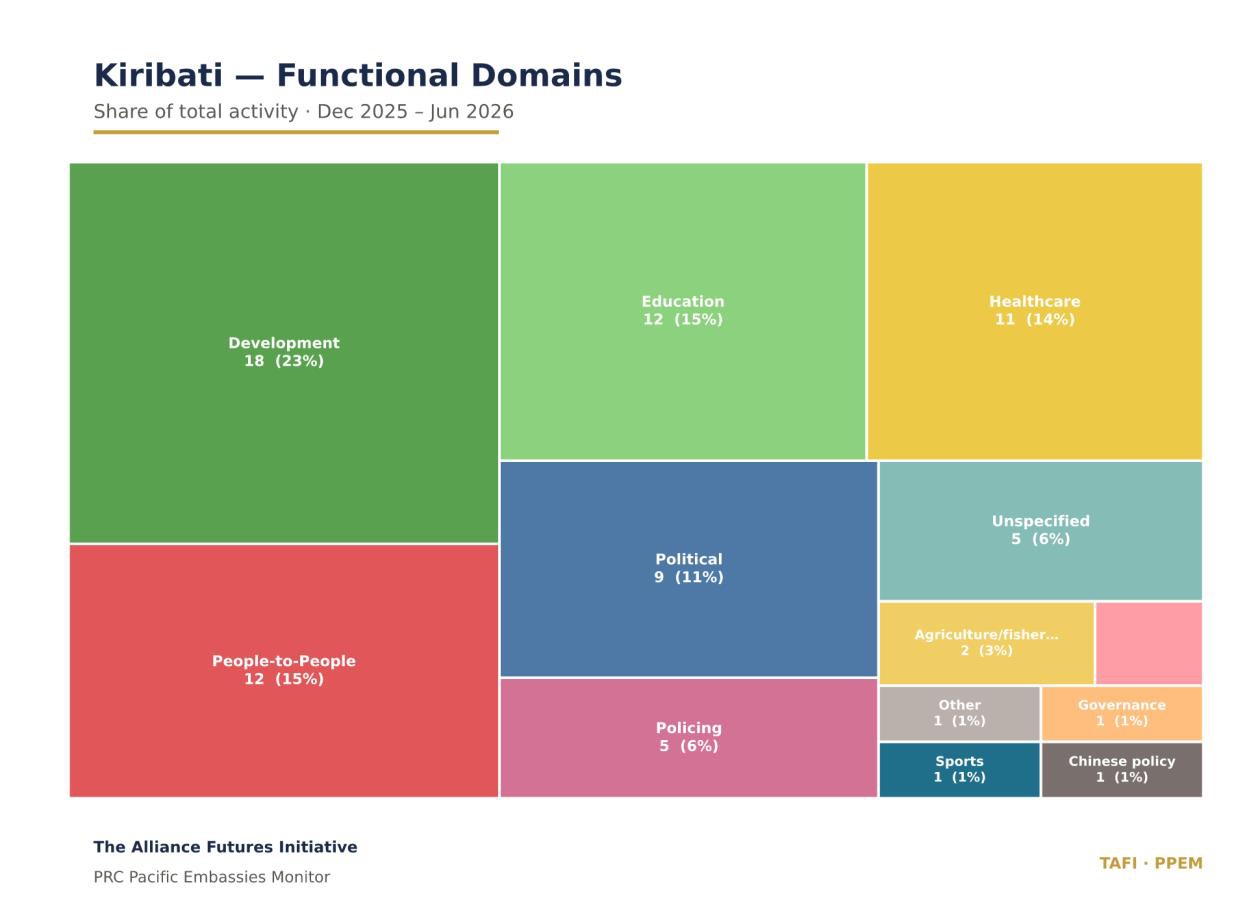
The Kiribati data shows the effect of a single event, Ambassador Zhou Limin’s departure, on an embassy’s publicized output. Development and healthcare activity held pace after Zhou left; political events dropped sharply. Where activity held steady, non-embassy actors drove most of it. Four of the recorded development events involved China Civil Engineering Construction Corporation (CCECC), a Chinese state-owned enterprise with an extensive presence across the Global South. CCECC implemented a road upgrade project in Kiribati during the collection period; project milestones and related agreements appear across the data. China-Aid officials hosted development-related seminars in China. The embassy continued to facilitate some development activity after Zhou’s departure—in March, Chargé d’Affaires Zhao Jian attended a handover ceremony for solar light kits donated by a Guangdong city.
Healthcare continuity reflects the Chinese medical team’s ongoing presence: the team drove nine of eleven healthcare events. The remaining two events were a meeting between the Chargé and Kiribati’s Health Minister and a medical equipment donation Chargé Zhao oversaw.
Political events concentrated almost entirely in January, when Ambassador Zhou held farewell meetings with Kiribati government officials. Zhou and his counterparts reviewed the bilateral relationship and the record of his tenure. These meetings were not generic as each readout reflected the specific responsibilities of the official on the other side of the table.
Activity Type
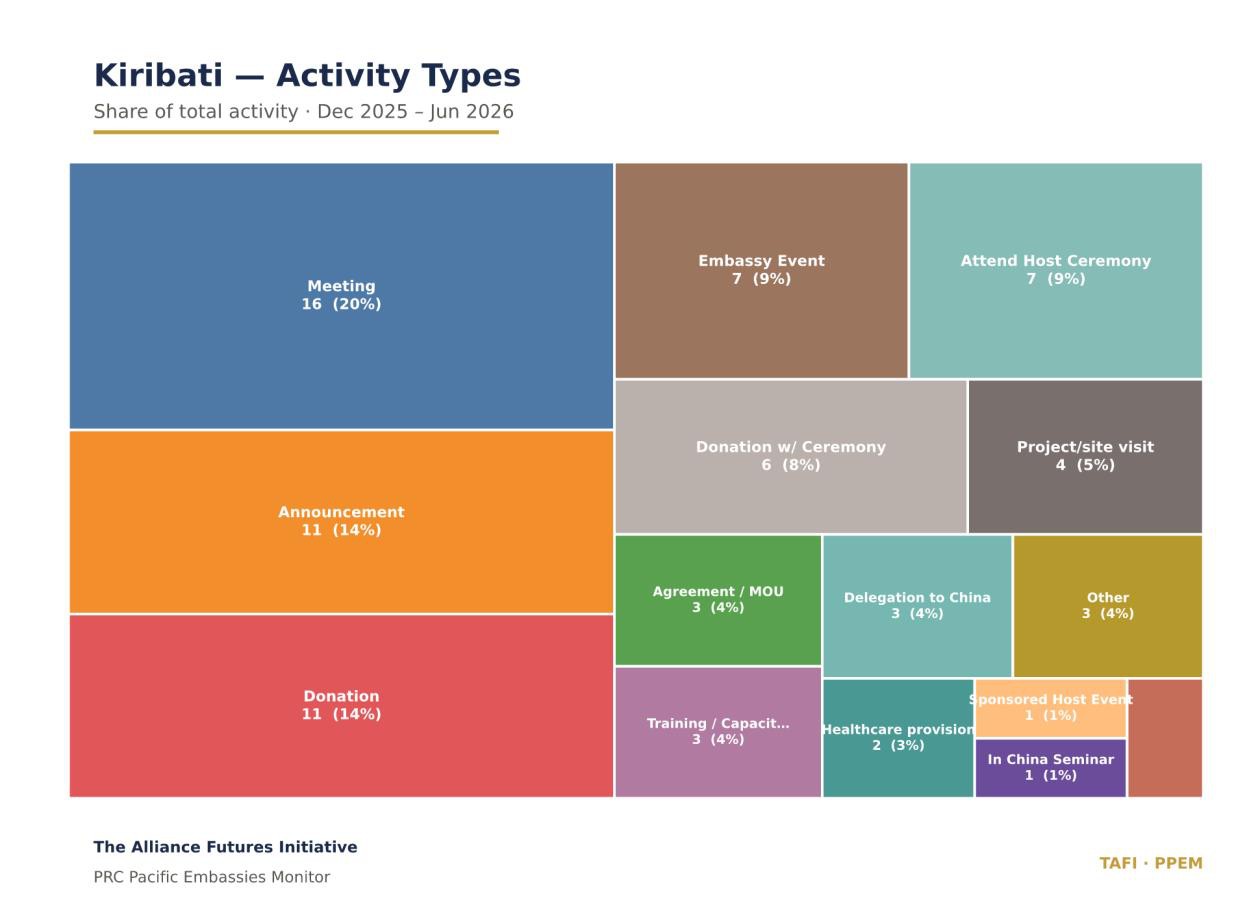
Kiribati’s activity type mix shows a higher share of announcements than most posts, driven by non-embassy actors in development and healthcare. CCECC publishes its road project milestones as announcements rather than holding ceremonies. Chinese medical teams follow the same pattern: the current team’s arrival and the addition of Traditional Chinese Medicine practitioners both appeared as announcements rather than events.
Two announcements stand apart from routine project updates. The first reported the rescue of I-Kiribati fishermen by a China National Fisheries Corporation vessel. The second was an embassy statement opposing US arms sales. Other posts deliver similar political statements through local media; Kiribati’s limited media environment means the embassy publishes them directly.
Naoero
Functional Domain
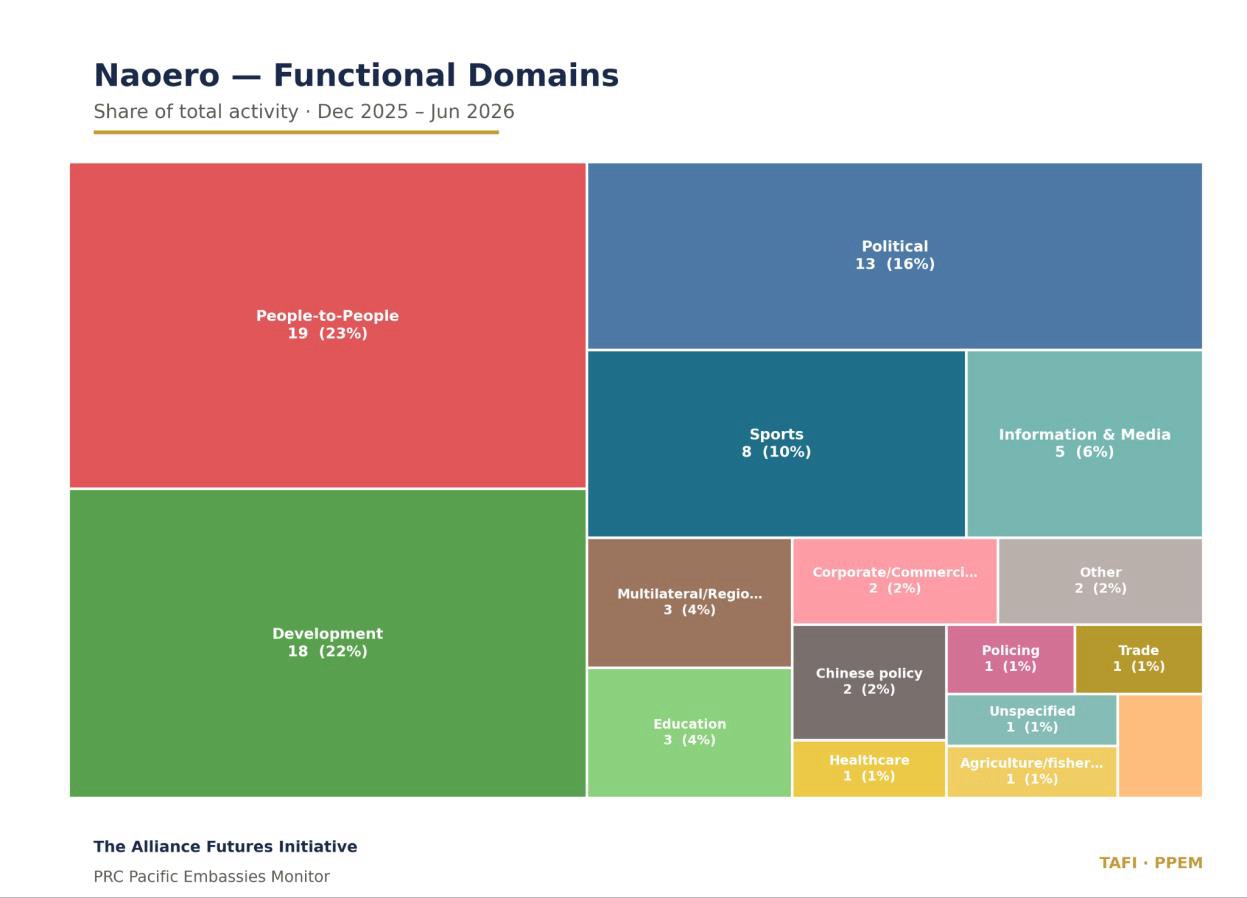
Naoero’s development and people-to-people share is unremarkable by regional standards, but the post records one of the highest concentrations of sports-related events. Most of this activity ties to Naoero hosting the 2028 Micronesian Games. Before Naoero switched recognition to the PRC in January 2024, Taiwan had pledged assistance for a large sports complex to house the games. Funding and building the complex was reportedly part of China’s offer to secure the recognition switch.
Early 2026 saw several implementation agreements signed and progress meetings with the Sports Minister. The complex broke ground in mid-May. Ambassador Lyu Jin also told the Sports Minister that China would consider donating equipment and providing training for Naoero’s preparation—an offer, not yet a commitment. The center will serve both the Micronesian Games and domestic events, including Naoero’s Independence Day celebrations.
Activity Type
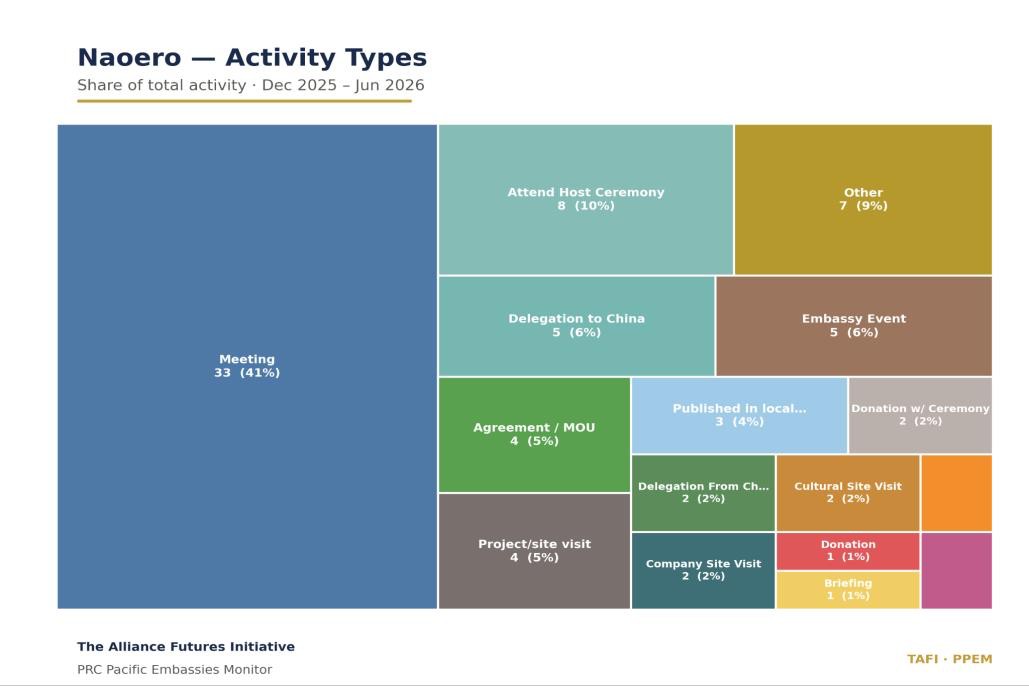
Naoero’s most distinctive feature is not the proportion of meetings, but who attends them. At most posts, the ambassador represents the Chinese side, and so it is in Naoero. What sets the post apart is the counterpart: President David Adeang appeared as the primary local participant in roughly a quarter of recorded meetings; ministers and other officials accounted for another quarter. Papua New Guinea shows a superficially similar pattern, but every recorded Marape meeting tied to a single delegation trip—remove the delegation and the pattern disappears. Naoero stands apart: no other post in this dataset shows a head of state accounting for a comparable share of recorded meetings.
Scale explains part of this distinction. Naoero is the smallest country this monitor tracks by both population and land area, and foreign policy decision-making—including development assistance—concentrates at the top more than in larger governments. Recorded meetings with Adeang fall primarily in the political domain, covering the bilateral relationship; two of eight meetings address development. The political concentration reflects relationship maintenance rather than working-level negotiation—these are not meetings for resolving technical details.
A secondary explanation may lie in the dynamic between Lyu and Adeang. Adeang appears as a counterpart more often than any other head of state or government across the nine posts. Whether this reflects a close working relationship, Naoero’s governing structure, or some combination cannot be confirmed from the data.
Papua New Guinea
Functional Domain
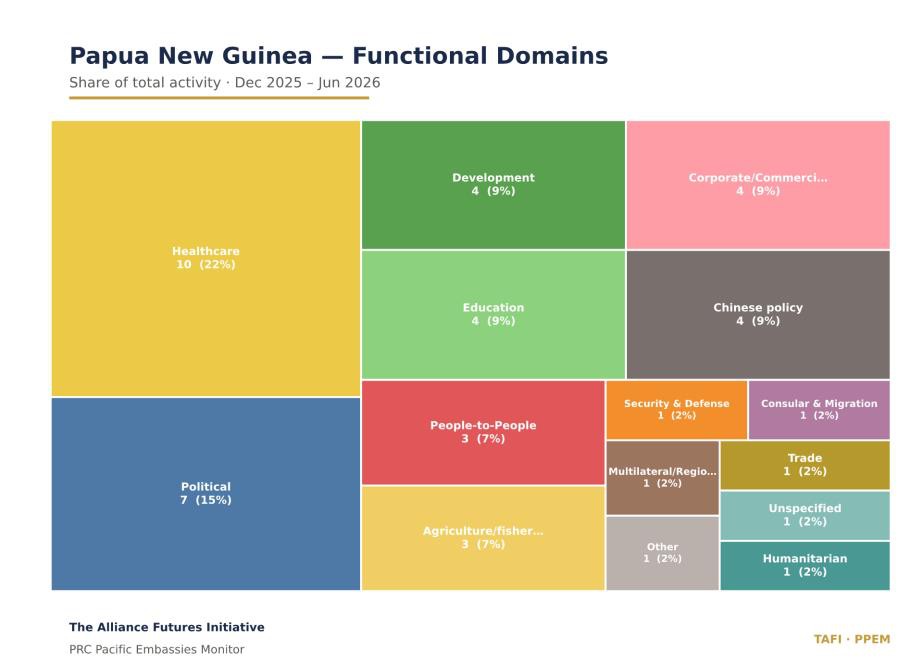
Healthcare dominates the PNG embassy’s activity mix, the highest share of any post. Events split evenly between the 15th China Medical Team’s healthcare provision and healthcare-related activity from other actors. The PLA Navy hospital ship Silk Road Ark visited Papua New Guinea in April, donated medical supplies to the PNG Defense Force, and treated thousands of Port Moresby residents. The ship had also visited Fiji and Tonga, but those visits pre-dated this monitor’s collection period. In May, PNG and Chinese health ministers met at the World Health Assembly and signed a memorandum of understanding on expanding medical cooperation.
Papua New Guinea also has the greatest proportion of activities related to commercial facilitation. This is more a reflection of significant events related to commercial diplomacy than total activity—must corporate facilitation activity is more routine and unlikely to be publicized. The appearance of corporate facilitation in other countries’ data is mostly meetings held at the Chinese embassy with various Chinese businesses operating in the host country. Two of PNG’s events took place during a delegation to China led by PNG Prime Minister James Marape that focused largely on commercial ties. In another example of how Chinese sub-national diplomacy operates, these events are all part of PNG engagement with Guangdong Province, which Xi Jinping delegated to PNG for economic relations.
Activity Type
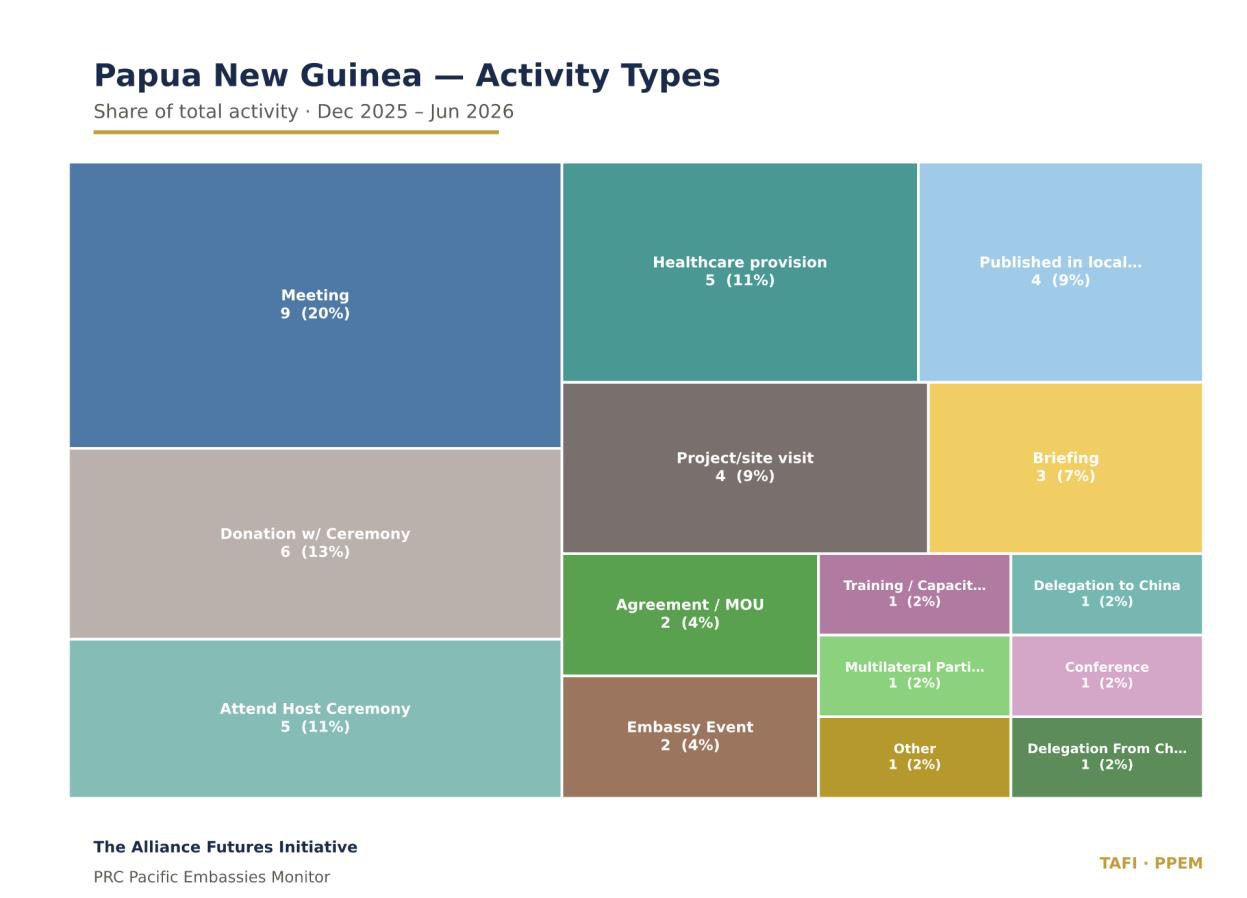
PNG’s activity type mix shows a high share of meetings, most concentrated around two events: the Silk Road Ark visit and Prime Minister Marape’s delegation to China. Unusually for this dataset, non-embassy officials led the majority of these meetings. Rear Admiral Fang Jinsong led the ship’s engagements in Port Moresby. During Marape’s Guangdong trip, he met the provincial governor, the developer of juncao technology, and a range of executives and business leaders. Ambassador Yang Xiaoguang attended many of these meetings but rarely led them.
Samoa
Functional Domain
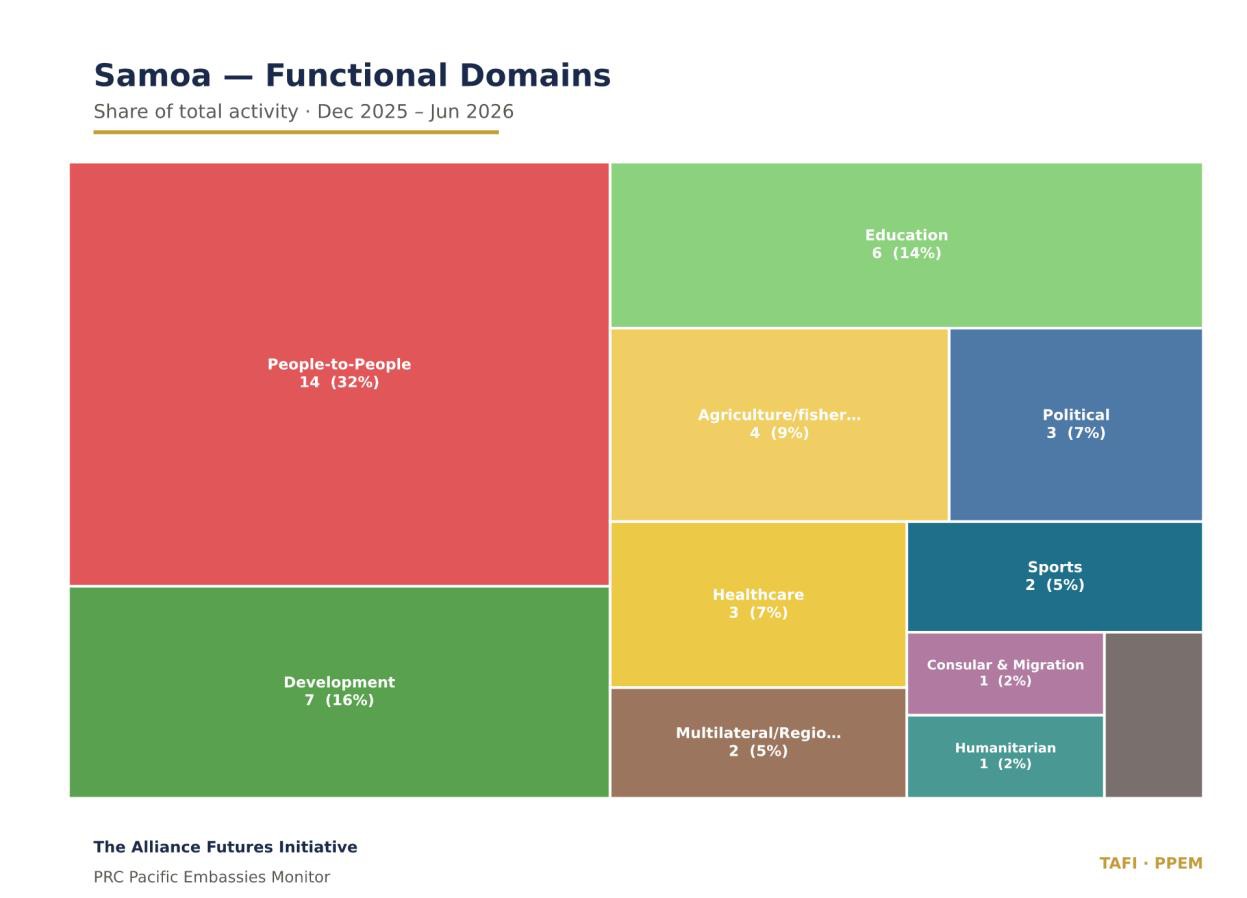
The Samoa embassy’s online presence tilts heavily toward soft power: people-to-people, agriculture, education, and sports-related activities account for half of all recorded events. One representative event is Ambassador Fei Mingxing’s February trip to Savai’i Island. Chinese medical team members traveled with Fei, providing free health checks. The Samoa-China Agricultural Technical Aid Project (SCATAP) delivered a demonstration on mushroom and watermelon cultivation. The group met with local villagers and officials and exchanged Lunar New Year greetings.
Only two events involved multilateral organizations, but both carry weight. The embassy donated US$200,000 to the Secretariat of the Pacific Regional Environmental Programme (SPREP) in Apia, shortly after the United States withdrew its own $200,000 contribution to the organization. Several months later, Special Envoy Qian Bo met with SPREP officials during a visit to Samoa. Qian also met the education minister and Prime Minister La’aulialemalietoa Leuatea Polāta’ivao Fosi Schmidt.
Activity Type
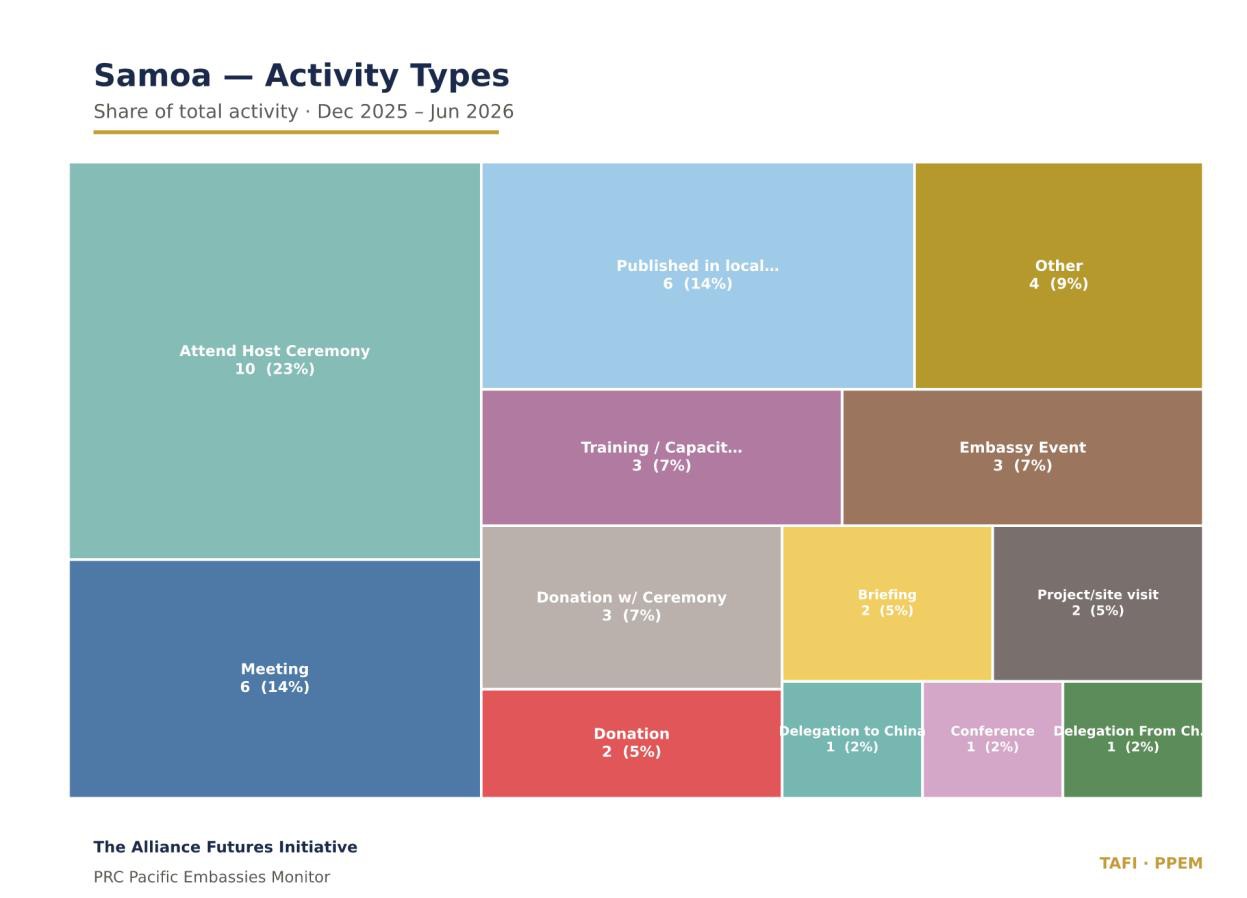
Samoa records a high share of embassy staff attending host ceremonies, which matches the high concentration of people-to-people events. As for embassy-hosted events, they mirror patterns seen across the region: two Lunar New Year receptions and one visit by a local elementary school for a cultural program. Embassy staff also attended a fashion show, a Museum Day celebration, a memorial service, and a local athletic competition.
Solomon Islands
Functional Domain
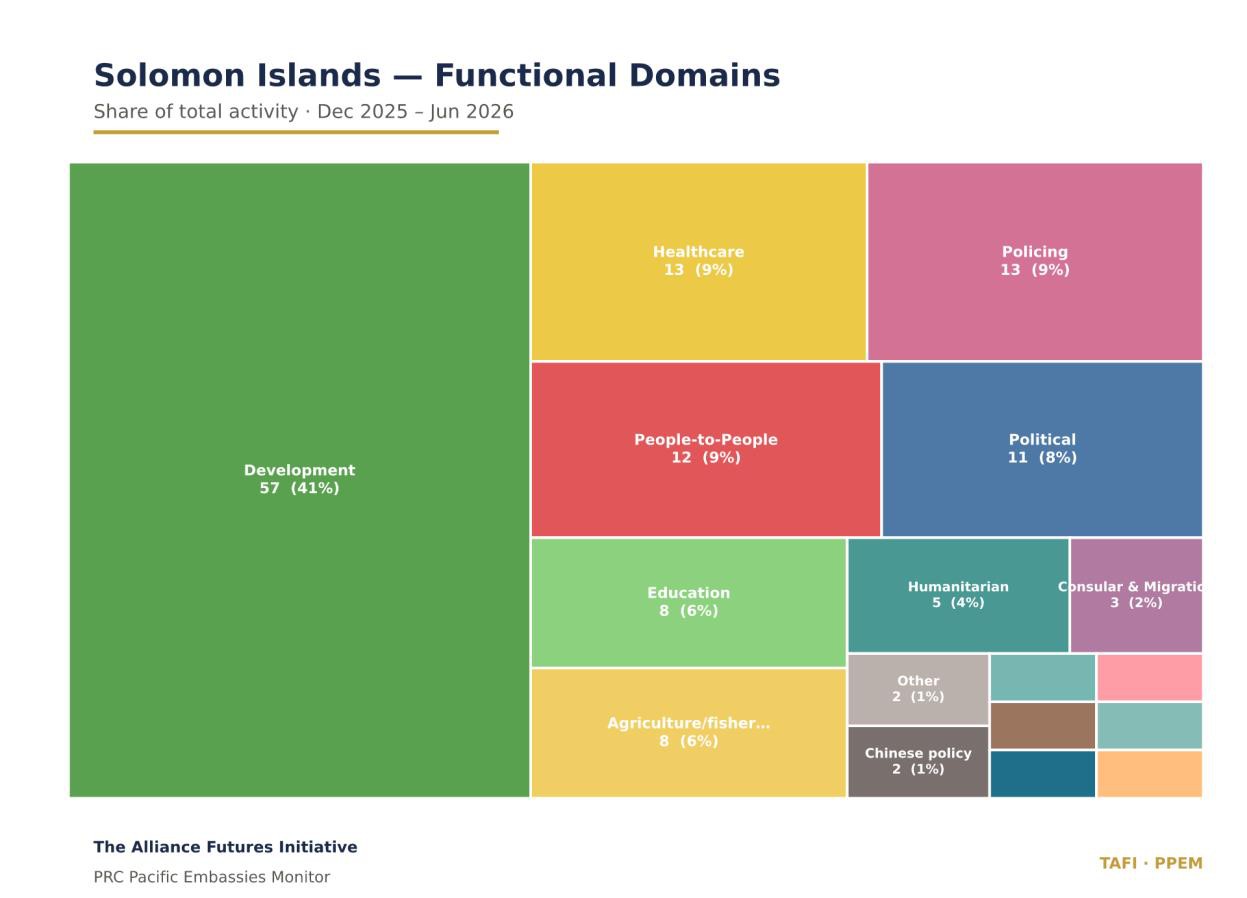
The Solomon Islands embassy records the highest concentration of development-related events of any post. Combined with agriculture and fisheries, these categories account for 46 percent of all recorded activity. Two programs drive most of this: the Solomon Islands National Broadband Infrastructure Project (SINBIP) and the Rural Sustainable Development Program (RSDP).
Under SINBIP, China Harbour Engineering Company Ltd. constructed 3G/4G Huawei telecommunications towers across the country (the full project numbering 161 towers were handed over to the government on 31 July). Under RSDP, the embassy channels PRC funding directly to the Solomon Islands’ 50 constituencies—typically SBD $1.5 million (roughly $185,000) per disbursement—working through the Ministry of Rural Development (MRD) and local Constituency Development Offices (CDOs) to deliver community infrastructure projects. The embassy also donated smaller amounts directly through CDOs, typically SBD $100,000 (roughly $12,400). Together these programs gave the embassy a widespread, frequent, and systematic development presence unmatched across the Pacific.
The delivery model also produces a measurement effect: RSDP and SINBIP generate many small, publicized events, so the development dominance partly reflects the programs’ visibility rather than necessarily greater substantive engagement. Even so, these two programs account for only 30 of 57 total development events; development would dominate without them.
Activity Type
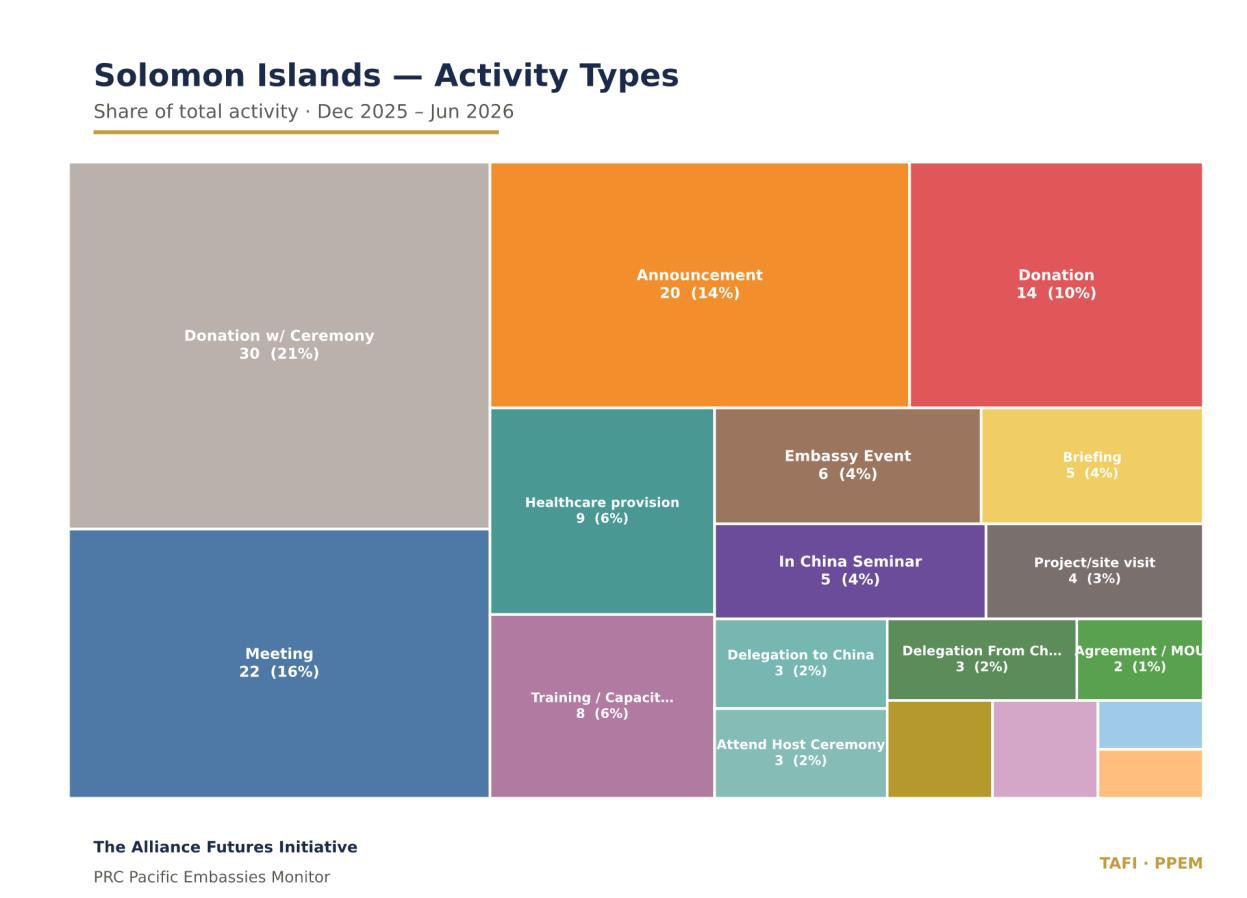
Donations with ceremonies are the most common activity type, a direct product of the RSDP delivery model. Every RSDP handover receives a small constituency ceremony: RSDP promotional banners go up, embassy representatives and Constituency Development Officers attend, and recipients deliver remarks. Smaller donations receive less ceremony, and completed Huawei tower installations appear as embassy announcements rather than events. Nearly half of recorded meetings address political topics: the bilateral relationship and adherence to the one-China principle.
Tonga
Functional Domain
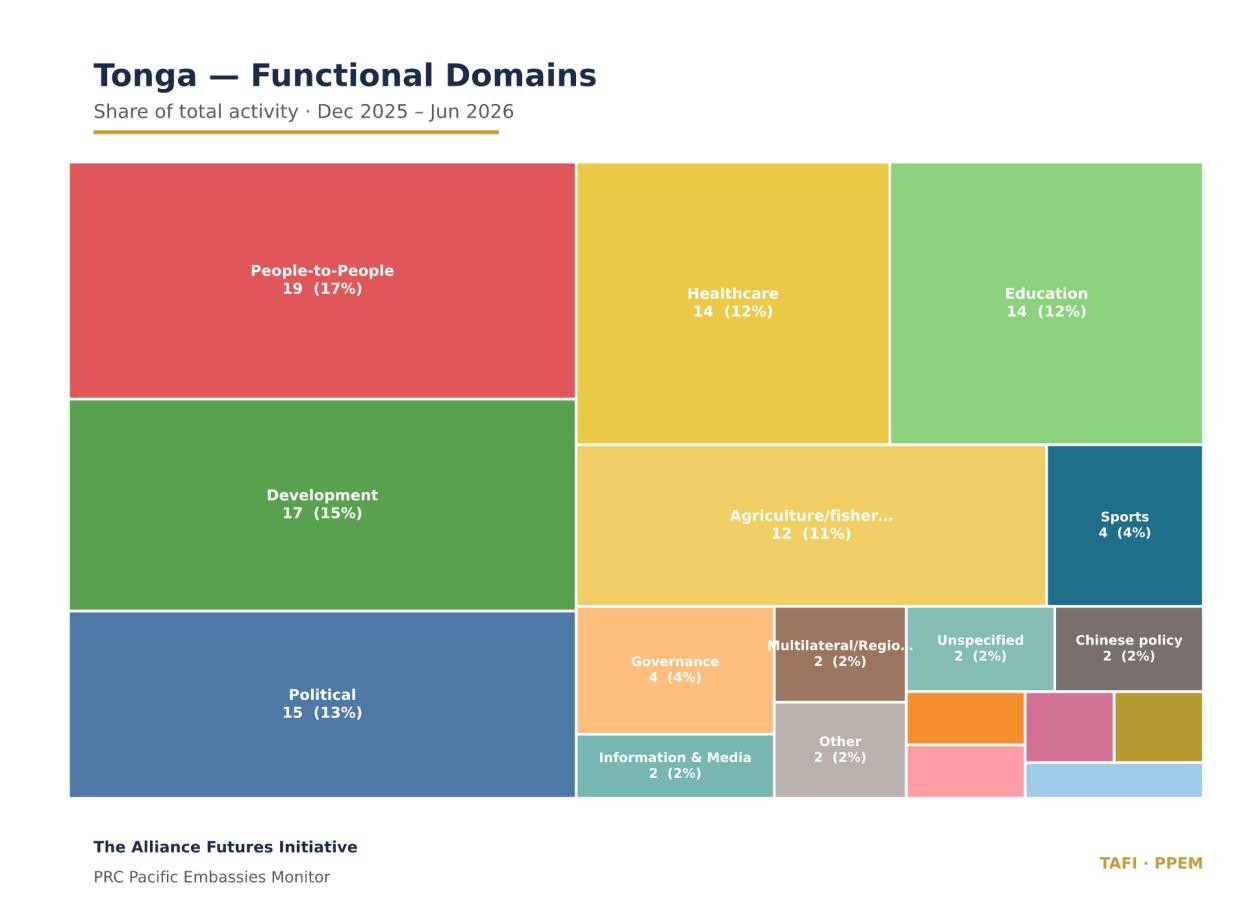
Tonga’s functional domain distribution is broadly standard, with people-to-people and development events roughly equal at the top. The post’s distinguishing feature is four governance-domain events—4 percent of the total, but higher than every post except Vanuatu. Two are public events: one on anti-corruption and one addressing the public service broadly. The other two events are distinct ministerial meetings: the Ambassador offered cooperation on developing Tonga’s taxation system in a meeting with the Minister for Revenue and Customs and met the Legislative Speaker to discuss parliamentary processes.
As in the Solomon Islands, a new government shaped Tonga’s activity distribution. Tonga’s November 2025 election drove a concentration of political events in December and January as the Ambassador held introductory meetings with new members of parliament and ministers. Unlike in the Solomon Islands, the election did not produce a spike in total events but does explain the political concentration during those months. These meetings focused on reaffirming bilateral relations and support for Beijing’s one-China principle.
Activity Type
Tonga’s activity type distribution does not surface the post’s most distinctive feature on its own: the volume of activity by Counselor Ruan Dewen. At most posts, non-heads of mission account for only a handful of recorded events, a product of both actual portfolio scope and each embassy’s reporting conventions. The Naoero embassy, for example, labels its website section “Ambassador’s Activities,” concentrating coverage on the ambassador by design. Most other embassy websites carry a single all-encompassing “Embassy Events” section but still report primarily on ambassadorial activity. The Solomon Islands is the one other post with meaningful non-ambassadorial coverage, but non-embassy actors drive the development program there and counselor-level appearances outside it are rare. Ruan’s portfolio spans education, sports, and agriculture—broader than those of any other counselor in this dataset—and the embassy reports it consistently.
Vanuatu
Functional Domain
Vanuatu’s data stands out for its policing share—the second highest of any post, behind only the Solomon Islands. Unlike in the Solomons, where policing events are more varied, Vanuatu’s consist almost entirely of donations and training. In December 2025, the Chinese police team ran a drone operations course for Port Vila police. A June training for the Southern Command of the Vanuatu Police Force covered crowd control and emergency response for mass-casualty incidents. Equipment donations came from several sources: China’s Ministry of Public Security donated office equipment to Vanuatu police in December; the Party Committee in Foshan, Guangdong, donated a patrol vehicle to Port Vila police.
Activity Type
Unlike most posts with a high people-to-people share, the Vanuatu embassy initiated its own non-donation events at twice the rate of those originating from the host country. Embassy-initiated events included a Lunar New Year reception, an International Women’s Day afternoon tea hosted by the ambassador’s spouse, a ceremony marking the 44th anniversary of China-Vanuatu ties, and a 105th CCP founding anniversary reception. The embassy also co-hosted the closing ceremony of the First Ordinary Session of the Vanuatu Parliament in 2026—a direct role in host-country parliamentary proceedings recorded at no other post. The parliament building served as the venue for the bilateral anniversary ceremony as well—a second instance of the embassy conducting a Chinese diplomatic event inside a sovereign parliamentary space.
* The PRC Pacific Embassies Monitor provides systematic, open-source tracking of Beijing’s public diplomatic activities across the nine Pacific Island Countries hosting Chinese missions. This Half-Year in Review consolidates the first seven months of collection, from 1 December 2025 to 30 June 2026.
TAFI is grateful for the support of Greg Brown, Leah Markworth, and William Janson. © 2026 OTX International. All rights reserved. No part of this report may be reproduced or transmitted without prior written permission from the publisher.