China’s Nauru Ambassador Hitches a Ride to Kiribati — Last Week in the Pacific
On 16 July, Papua New Guinea’s Government announced that it would no longer recognize the Taipei Economic Office in PNG, the latest concession to Beijing’s one-China principle.
PNG has previously closed its own trade office in Taiwan, a move Trade Minister Richard Maru framed at the time as a condition for the Framework Agreement for economic cooperation he had signed in Beijing in May 2026.
This closure follows the same pattern: a diplomatic concession tied to deliverables from China. Maru met with China’s ambassador on 10 July to discuss the upcoming PNG–China Trade Expo in October 2026.
Summary of PRC Activity
China’s Ambassador to Nauru accompanied President David Adeang on a state visit to Kiribati for the country’s 47th independence day. Solomon Islands Foreign Minister Rick Houenipwela traveled to Beijing, where he met with Foreign Minister Wang Yi and signed an economic agreement with the Ministry of Commerce. Papua New Guinea closed the Taipei Economic Office in Port Moresby.
(Source: Government of Naoero)
This Week’s Big Themes:
China’s Naoero Ambassador Hitches a Ride to Kiribati
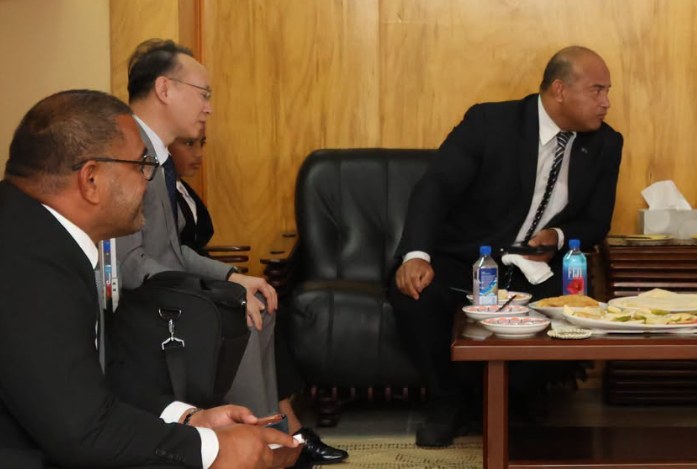
At Kiribati’s invitation, Nauru’s President David Adeang traveled to Tarawa on 13 July for Kiribati’s 47th independence day celebrations. The visit was routine, but the company Adeang kept was not. China’s Ambassador to Nauru, Lyu Jin, accompanied Adeang to Kiribati—the first instance this monitor has recorded of a PRC ambassador traveling alongside an intra-Pacific delegation outside of trips to Beijing.
Lyu appeared alongside Adeang at most publicized events during the visit. Upon arrival, Adeang and Lyu met with Kiribati’s Minister for Tourism, Commerce, Industry, and Cooperatives, Tangariki Reete. The pair also attended an independence eve gala. During the independence day celebrations, Lyu sat directly above the Chargé d’Affaires Zhao Jian from China’s Kiribati embassy. This monitor could not confirm whether Lyu accompanied Adeang to a state dinner hosted by Kiribati’s President; neither the Nauru nor the Kiribati Chinese embassy publicized the event. All sourcing for this entry comes from Nauru’s government social media—Lyu’s presence is confirmed through photos with no textual references.
Why Lyu made the trip is not confirmed, but two explanations are plausible. The simpler one is proximity. Lyu appears alongside Adeang in roughly a fifth of Nauru’s tracked public events—more than any other ambassador–leader pairing across the nine posts this monitor tracks. That closeness likely reflects Nauru’s limited governing capacity as much as any personal tie—a small government concentrates engagement at the top—and may point to an outsized Chinese role in facilitating Nauru’s external engagements. A second explanation is institutional. China’s Kiribati embassy has lacked an ambassador since Zhou Limin departed in February 2025, and Beijing may have wanted a message carried to Tarawa by someone of higher rank than a chargé d’affaires.
Supporting Events
- Kiribati: Independence Day Celebrations
- Naoero: David Adeang and Lyu Jin Attend Gala
- Naoero: Delegation Reception in Kiribati
Solomon Islands’ Foreign Minister Visits China
Solomon Islands Foreign Minister Rick Houenipwela traveled to China from 10–15 July for a series of meetings. Hou’s first stop was Jiangsu Province, where he met with Vice Governor Zhao Yan, who had led a delegation to the Solomon Islands in late June for talks on deepening cooperation. The pair likely met then as well, though this monitor could not confirm it. Jiangsu’s engagement with the Solomon Islands runs through its sister-province relationship with Malaita—Hou’s home province. The Jiangsu meeting covered agriculture, education, technology, and skills development—themes that carried through the rest of Hou’s trip. China’s Special Envoy to the Pacific, Qian Bo, also attended. Whether he accompanied Hou for the rest of the visit is unknown.
In Beijing, the Solomon Islands Embassy hosted a meeting between Hou and Solomon Islanders studying in China. Hou then met with Chen Xiaodong, Chairman of the China International Development Cooperation Agency (CIDCA). Hou outlined key planks of the GREAT Government’s platform, including free education and reduced energy costs. Chen expressed CIDCA’s willingness to align programming with these goals.
Hou’s meeting with Foreign Minister Wang Yi—who also serves as Director of the Central Committee Foreign Affairs Commission Office—was the visit’s centerpiece and the highest-level bilateral engagement between China and a Pacific Island country since Tongan King Tupou VI’s meeting with Xi Jinping last November. The two discussed the same cooperation areas as Hou’s previous meetings. Wang Yi also confirmed that a Hong Kong–Solomon Islands visa exemption arrangement was approved and near completion. Wang Yi committed US$1 million for disaster relief following Cyclone Malia and a further US$10 million for the Rural Sustainable Development Program. Hou closed the trip by signing a Framework Agreement to upgrade the bilateral economic partnership with Commerce Minister Wang Wentao. No further details on the agreement have been provided.
Supporting Events
- Solomon Islands: Rick Hou Meets with Jiangsu Vice Governor
- Solomon Islands: Rick Hou Hosted at SI Embassy Beijing
- Solomon Islands: Rick Hou Meets with CIDCA
- Solomon Islands: Rick Hou Meets with Wang Yi
- Solomon Islands: Rick Hou Signs Economic Framework Agreement
* The PRC Pacific Embassies Monitor provides systematic, open-source tracking of Beijing’s public diplomatic activities across the nine Pacific Island Countries hosting Chinese missions. The monitor captures official embassy social media and website posts, supplemented by local sources, to offer a weekly structured intelligence report that bridges critical information gaps on regional engagement.