Fiji Picks Australia; China Stays Anyway — Last Week in the Pacific
China’s Pacific embassies extended their CCP anniversary programing into a second week—this time trading receptions for talanoa, or open dialogue.
In Fiji, Kiribati, and Tonga, ambassadors convened senior officials for discussions on governance experiences, using the anniversary as a platform to deliver lessons from China’s political model. In Fiji, the embassy widened the invitation to include political parties across the spectrum.
The pattern mirrors China’s Five-Year Plan promotion campaign: ambassadors carry Beijing’s governance model directly to Pacific political circles, framing it as a development resource rather than an ideological pitch.
Summary of PRC Activity
China’s Pacific embassies posted a quieter week than recent weeks, but military engagement with Fiji stood out. On 2 July, the PRC embassy donated to the Fijian military. Days later, China’s defense attaché in Fiji toured the Third Battalion Fiji Infantry Regiment.
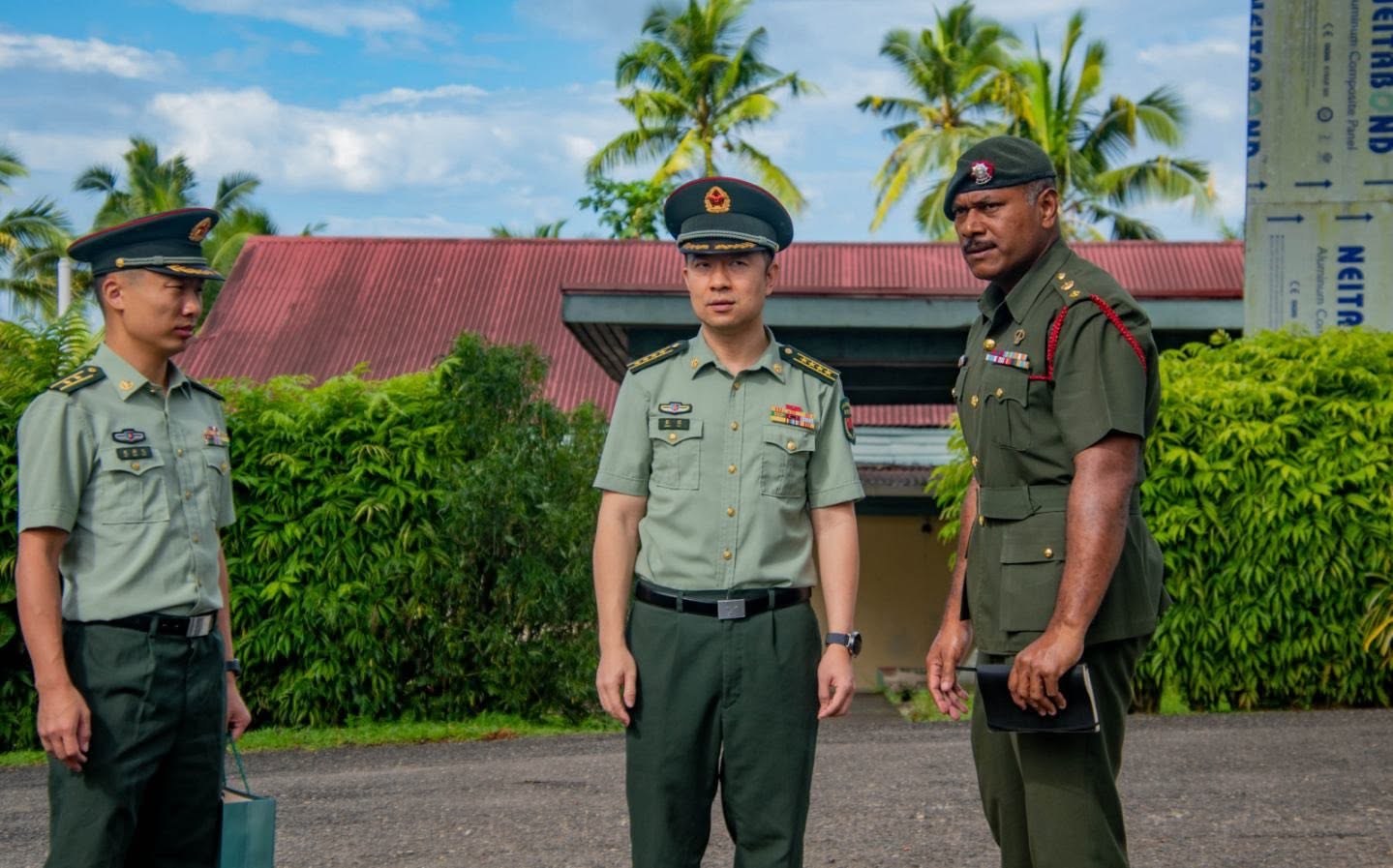
(Source: Third Battalion Fiji Infantry Regiment Facebook)
This Week’s Big Theme:
China–Fiji Military Engagement
Shortly after Australia and Fiji signed the Ocean of Peace Alliance—a mutual defense agreement open to other Pacific parties—China tested a submarine-launched ballistic missile across the Pacific. The warhead landed roughly 1,000 km northeast of the Solomon Islands, near Kiribati and Tuvalu. Pacific states had less than 24 hours’ notice. Most Pacific leaders condemned the test.
Solomon Islands Prime Minister Matthew Wale issued the sharpest response, saying the test was not something a friend does. Fiji’s Ministry of Foreign Affairs released a measured statement calling for dialogue and respect for regional development cooperation, and reaffirmed the Treaty of Rarotonga.
While the missile launch drew heavy media coverage, China’s military had been working Fiji’s defense establishment all week. China’s Yuan Wang 5—a space and missile tracking ship—sat in a Fijian port during the test. Fiji’s Defence Minister Pio Tikoduadua called it a strange coincidence.
On 2 July, the PRC Embassy in Fiji donated roughly US$70,000 to the Republic of Fiji Military Forces (RFMF) for construction of a new building for the RFMF Wives Committee. China’s Defense Attaché Senior Colonel Zhang Yu presented the donation to RFMF Chief of Staff Brigadier General Sapenafa Motufaga. On 6 July, Zhang attended the birthday celebration for Major General Ro Jone Kalouniwai, Commander of the RFMF.
On 8 July, Zhang made his first visit to the Third Battalion Fiji Infantry Regiment (3FIR)—a visit the battalion publicized on Facebook, noting it “strengthen[ed] friendship between the RFMF and People’s Liberation Army.” The trip followed a courtesy call 3FIR’s Commanding Officer had made to the Chinese embassy, suggesting the relationship runs in both directions. Zhang received an operations briefing from the Acting Operations Officer, toured selected facilities, and received what 3FIR described as insights into its “operational capabilities, infrastructure, and working environment.” Both Zhang and 3FIR’s Commanding Officer presented remarks on the importance of continuing military engagement and cooperation.
Fiji signed with Australia, and Beijing did not blink. Within the same week—missile test included—China’s defense attaché handed the RFMF a donation, attended the Commander’s birthday, and walked the floors of a frontline battalion. Australia penned an alliance, but China maintained its access.
Supporting Events
- Fiji: Donation to RFMF Wives Committee
- Fiji: Commander RFMF Birthday Celebration
- Fiji: Chinese Defense Attaché Visits 3FIR
* The PRC Pacific Embassies Monitor provides systematic, open-source tracking of Beijing’s public diplomatic activities across the nine Pacific Island Countries hosting Chinese missions. The monitor captures official embassy social media and website posts, supplemented by local sources, to offer a weekly structured intelligence report that bridges critical information gaps on regional engagement.