I. Executive Summary
This report synthesizes findings from a strategic Red Team exercise examining PRC objectives and decision-making in the Pacific Islands region. The exercise consisted of expert participants roleplaying PRC officials to assess potential responses to four regional scenarios.
Key Findings
The PRC may perceive that it is winning the influence game not through military might but through patient, systematic relationship-building.
- Strategic Opportunism: The PRC employs a dual-track approach in the Pacific Islands, pursuing short-term objectives to diminish U.S. influence while working toward long-term goals of becoming the region’s primary partner. PRC activities aim to fracture regional alliances, create economic dependencies, and normalize PLA presence without triggering U.S. military responses.
- Political Warfare Predominance: The PRC perceives a firm U.S. red line—direct threats to U.S. military assets. Beijing believes it can conduct unrestricted political and economic warfare through information operations, economic coercion, and dual-use infrastructure development.
- Narrative Control: Maintaining the appearance of a “benign development partner” while pursuing strategic objectives is a critical element of PRC strategy. This approach masks China’s geostrategic ambitions and enables continued influence operations.
- Exploiting Strategic Flexibility: Unlike Western powers constrained by trying to maintain the status quo, China seeks to benefit from multiple possible outcomes, including regional instability and separatist movements that create opportunities for Chinese involvement under the guise of stabilization.
Scenario-Based Insights
The exercise examined four scenarios yielding strategic insights:
- Kanton Island Lease, 2029: Given the opportunity, the PRC would avoid a formal military base on Kanton Island due to its proximity to the U.S. and expected backlash. The PRC would instead construct dual-use infrastructure, using the island for intelligence gathering and as a regional assistance hub.
- Deep-Sea Mining Competition, 2027: The PRC would exploit any U.S. bypassing of international norms to damage America’s global reputation, expand regional initiatives in science and technology fields, and use seabed mining as a wedge issue at strategic weak points across the Pacific.
- Marshall Islands Diplomatic Switch, 2028: The PRC would capitalize on favorable political winds to establish diplomatic recognition and focus on a patient, multi-generational approach to engineer long-term diplomatic realignment.
- Bougainville Crisis, 2027: The PRC would posture to benefit strategically regardless of political or conflict outcomes, reinforcing regional security and economic influence as the priority. Bougainville provides the PRC with an opportunity to demonstrate responsible partnership through investment and peacekeeping.
Recommendations for Western Responses
-
Western responses to the PRC’s “better partner” narrative should focus on specific instances where Chinese promises have not materialized or have come with hidden strings. Unlike Western partners, China has positioned itself as the “helpful partner” that does not lecture Pacific Island states about governance or human rights. This narrative is powerful because it contains enough truth to be believable. A counter-strategy needs to be surgical and evidence-based. For example, it could highlight debt burdens from Belt and Road projects, environmental damage from PRC-funded infrastructure, or cases where Chinese workers displaced local labor. The key is letting Pacific Islanders tell these stories rather than having Western officials make accusations.
-
Support independent media by providing practical resources such as training, equipment, and sustainable funding models for local journalists to investigate and report on PRC activities. This approach would create indigenous accountability rather than foreign propaganda. Presence and visibility matter.
-
Western development projects need better marketing. Too often, a PRC-funded project gets a grand opening ceremony while a Western-funded project operates quietly in the background.
-
Develop comprehensive counter-political warfare strategies that recognize the PRC’s advantage in non-kinetic competition. Beijing excels at “political warfare” and using non-military tools to achieve strategic objectives. The PRC coordinates economic incentives, cultural exchanges, elite networking, information operations, and diplomatic pressure as integrated campaigns. In comparison, Western responses appear fragmented with minimal or ineffective coordination.
A comprehensive strategy requires building personal relationships with Pacific Island leaders. Western partners need to show up consistently, not just during crises. High-level visits or summits are not a substitute for the important “last three feet of diplomacy.”
-
Analyze strategic maneuvers in foreign policy with consideration for the PRC’s domestic politics and the CCP’s internal dynamics. President Xi’s strategy is not only about containing the U.S. or accessing resources—it also demonstrates to the Chinese people that the CCP is reclaiming its historical great power self-image and status.
Pacific Island states flipping recognition from Taipei to Beijing or voting with the PRC in international forums provides domestic legitimacy for Xi’s leadership. Successful infrastructure projects and policing programs become propaganda showcasing the superiority of the PRC development and partnership model.
Understanding these domestic incentives helps predict PRC behavior and identify potential pressure points. For instance, PRC projects that fail or generate negative publicity become domestic political liabilities for Xi. These outcomes suggest that highlighting PRC failures could have effects beyond the immediate Pacific context.
-
Anticipate how the PRC benefits from apparent chaos and instability to prepare appropriate countermeasures. Beijing is exceptional at turning Western mistakes and regional instability to its advantage. When Pacific Island states face crises—natural disasters, economic downturns, or political instability—China provides immediate assistance while Western aid often gets caught in bureaucratic processes.
The countermeasure is not simply faster response times but understanding that the PRC views apparent chaos as opportunity. Political transitions in Pacific Island states are moments when new leaders might be receptive to changing foreign partnerships, and economic crises create openings for new financial arrangements.
Western partners need early warning systems and pre-positioned response capabilities—for instance, more U.S. Coast Guard presence in American Samoa. More importantly, they need to recognize that maintaining influence requires constant engagement and not just crisis response.
II. Introduction
The Imperative
As the great power competition between the United States and the PRC heats up, the Pacific Islands region, once again, appears increasingly critical for military power projection, diplomatic influence, and access to natural resources. This is the pivot region of global strategy—presenting both strategic opportunities and challenges for the U.S. and the PRC. Local contexts can quickly change, but the PRC has a long-term strategy for the region, allowing it to adapt to different political, security, and economic circumstances. In this context, the United States and its regional partners need to stay ahead of the curve—developing and implementing forward-looking, flexible strategies that anticipate PRC maneuvers to sustain influence and stability in the region.
Exercise Background
Conventional wisdom suggests that the People’s Republic of China’s strategic objectives in the Pacific Islands region are multifaceted: to secure access to resources, establish military and intelligence footholds, isolate Taiwan diplomatically, reduce U.S. and allied influence, and reshape regional governance structures to advance its interests. Beijing seeks to complicate U.S. power projection by strengthening its presence along critical sea lines of communication through the Second Island Chain, potentially constraining U.S. naval operations from Guam and other territories.
To these ends, the PRC’s diplomatic footprint has expanded over the past decade and Beijing has roughly tripled its diplomatic personnel in the region since 2015. President Xi Jinping’s visits to Fiji in 2014 and Papua New Guinea in 2018 underscore the strategic priority the PRC assigns to the region. Beijing has established embassies across the Pacific and frames its diplomatic engagement in terms that emphasize non-interference and sovereignty—a message that resonates with some Pacific Island peoples.
In general, the PRC’s approach to the Pacific Island states combines strategic opportunism with economic leverage through the Belt and Road Initiative, offering infrastructure projects that may create dependencies. Recent agreements with the Cook Islands on a raft of issues, including deep-sea mineral exploration; the Solomon Islands security pact; recent, current, and projected police cooperation with Fiji, Kiribati, and Vanuatu signal Beijing’s evolving strategy from purely economic engagement to security cooperation.
Objectives
The purpose of this Red Team exercise was to systematically identify vulnerabilities, gaps, and blind spots in the current security posture and strategic planning of the U.S. and its allies and partners in the Pacific region by adopting an adversarial mindset.
The exercise stimulated new thinking and stakeholder appreciation for why and how PRC strategists may determine whether and how to advance the PRC’s interests among Pacific Island countries in circumstances short of kinetic conflict. The exercise explored:
- PRC perceptions of its own interests in the region
- PRC perceptions of the interests of states in the region, and key external states
- PRC red lines, what conditions Beijing may consider necessary to maintain its equities, and how Beijing may seek to alter relations among regional states to secure advantages
- Strategic decision-making, wherein governments and leaders have incentives to obscure their calculations
A key component of this Red Team approach was the development of strategic empathy to cultivate the ability to understand adversarial perspectives, motivations, and decision-making processes. By systematically exploring adversaries’ perspectives, motivations, and decision-making frameworks, we can better anticipate what opponents will do next, build better defenses by understanding adversary objectives, and take initiative instead of responding to challenges.
Exercise and Report Format
Red Team analysis challenges conventional thinking by having analysts adopt the perspective of an adversary or competitor. This structured analytic technique requires analysts to shift from observing opponents to becoming actors who think and respond as the adversary would. The method proves especially valuable when facing counterparts with different cultures, values, or decision-making processes.
Red Teams immerse themselves in their assigned roles, producing authentic products like policy papers and strategic recommendations that the adversary might create.
The technique helps organizations identify blind spots, test assumptions about adversary behavior, and develop more robust strategies. By forcing analysts to see situations through opponents’ eyes, Red Team analysis reveals vulnerabilities and alternative courses of action that might otherwise go unrecognized.
The exercise ran for one day with a team of eight expert participants—scholars and practitioners from Pacific Island countries, the United States, and the Antipodes—adopting the Red Team role of PRC military and diplomatic officials, foreign policy strategists, and technical advisors to the PRC Foreign Minister. Individual Red Team members did not play specific roles but rather conferred in “committee” style to represent views across PRC statecraft domains. The workshop facilitator encouraged dissenting views about the group’s assessments and recommendations, and employed the Chatham House Rule to encourage speculation and open discussion.
The first workshop activity provided the participants with their directive and established a baseline understanding of the PRC’s objectives in the Pacific. The facilitator asked participants to “not just answer what the PRC should do, but why it should do it” under a variety of conditions and several scenarios. To ensure methodological rigor and replicability, the facilitator regularly asked participants to maintain the “red” mindset. Conversations were fruitful and the participants were not always in agreement—with some participants advocating a more aggressive overall strategy and others greater restraint. The authors compiled a synthesis of these conversations presented below.
With a baseline established, the facilitator presented the participants with the four scenarios, each a notional representation of possible developments representative of broader ongoing trends. This report presents each of the scenarios as a fictional policy memo presented to Wang Yi. The background text is the exact language provided to the Red Team. While the discussions during the exercise were wide-ranging, the authors distilled each portion into its core elements.
The final section of the report includes the takeaways about China’s Pacific strategy and lessons for the “blue” team—the U.S. and partnered countries in the region. Although informed by discussions between the participants, this section is the result of the authors’ own analysis of the workshop.
III. Directive and Baseline Strategy
Long-term
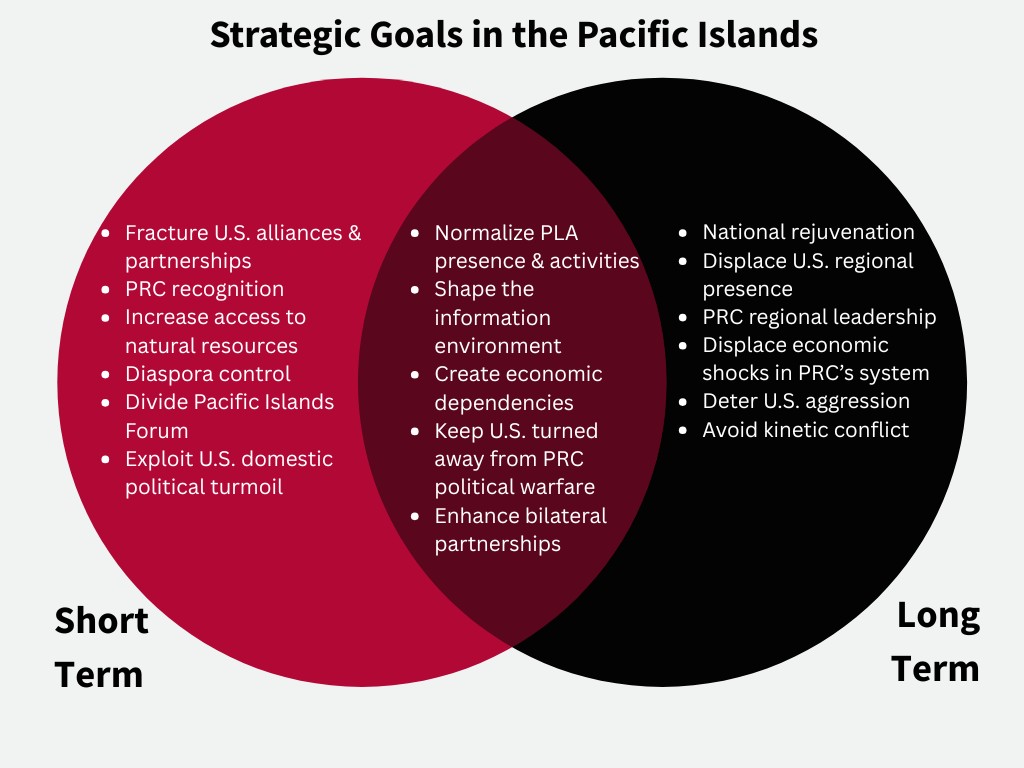
Building on short-term goals, the PRC will become the region’s primary partner. Achieving national rejuvenation and regional leadership will come at the expense of the United States’ eagerness to dominate and control the Pacific Islands. The PRC will therefore displace U.S. regional presence while deterring U.S. aggression. Kinetic warfare must be avoided with the United States and its allies and partners. Leadership in the Pacific Islands will also buttress against economic shocks in the PRC system.
Short-term
In the short term, the PRC seeks to diminish U.S. influence in the Pacific Islands while establishing a stronger foothold in the region. This begins with fracturing U.S. alliances and partnerships, particularly with COFA states like the Federated States of Micronesia. Exploiting U.S. domestic political turmoil and distancing the United States from its Pacific Islands relationships will provide better grounds for the PRC to establish itself. Another key area for division is in the Pacific Islands Forum. Disunifying these members will help make way for the PRC to provide support to the region. Taiwan offers a valuable wedge for dividing the Forum and splitting the region. In the move to increase Beijing’s influence in the region, there must be more PRC recognition. This can be achieved through showcasing PRC projects in the region and using Chinese nationals in the Pacific Islands to promote the friendship and development the PRC provides. To the PRC’s benefit, Beijing must also work to gain greater access to the Pacific Islands’ natural resources. Such efforts will disincentivize the region from trusting the United States, while further legitimizing the PRC as a favored partner.
Overlapping
Where short-term and long-term goals meet, the PRC will position itself to be the transformative power in the Pacific Islands. This overlap occurs in several domains: partnerships, narrative control, and U.S. evasion. Enhancing bilateral partnerships and normalizing the People’s Liberation Army (PLA) presence and activities in the Pacific Islands will help embed the PRC into the region. During these efforts the PRC will control the narrative and shape the information environment. This will reduce friction between the PRC and Pacific Islands. Making the Pacific Islands economically dependent on the PRC can also give the nations reason to maintain bilateral relationships with Beijing. Keeping the United States turned away from PRC political warfare and information campaigns will be necessary to achieve these overlapping goals.
IV. Scenario Memos
Kanton Island Lease
FROM: Pacific Islands Working Group
DATE: 24 June 2029
SUBJ: Kanton Island Lease
The PRC successfully consolidated political influence in Kiribati, forging a 99-year lease on Kanton Island—a key strategic asset in the Pacific. While the access to the island could disrupt U.S. military operations in any potential Pacific contingency, overt militarization risks strong backlash. Moving forward, the PRC should focus on dual-use infrastructure development, intelligence gathering, and soft-power projection to expand influence while minimizing the risk of confrontation.
By 2028, as Western relations with Kiribati soured, our diplomacy remained consistent. Judicial independence in Kiribati is finished, and the legislature merely rubber-stamps presidential decrees. PRC law enforcement trainers now maintain a perennial presence, officially serving as security advisors while effectively enforcing regime control, including assistance monitoring polling stations during the 2028 elections.
Following these elections, the PRC completed renovations on Kanton Island’s airstrip and secured a 99-year lease for a portion of the island. A signed but not yet publicized Memorandum of Understanding permits us to use this territory for our own military purposes, though new construction hasn’t begun.
The PRC’s military strategy in the Western Pacific would benefit from a forward military base on Kanton Island. Kanton Island, with its recently constructed airstrip 1,900 miles from Pearl Harbor, is well suited for operations across all domains to include basing nuclear submarines. These actions would complicate U.S. contingency planning. Beyond operational objectives, a military presence would distract the U.S. from our other activities in the region.
Despite the above benefits, forward basing would prove contrary to China’s regional and national interests. Deploying military assets within relative proximity to Pearl Harbor would trigger a reaction inimical to the PLA’s warfighting plans. China’s political warfare in the Pacific has elicited vocal reactions from Washington; a tangible threat would spur action across the region.
The maximally effective use of the lease on Kanton Island is not a military base, but the construction of dual-use infrastructure to build our interests and counter the Americans.
- Promote Strategic Infrastructure. Utilize state-owned enterprises to construct dual-use infrastructure—including a deep-water port. Expand commercial activity through intensive agriculture and explore the plausibility of opening a casino in Kanton. Turn a blind eye to criminal activity by CCP-aligned groups to weaken the rule of law. All infrastructure should be built to support PLA operations in the event of a conflict.
- Conduct Intelligence Operations. The Ministry of State Security and PLA should utilize newly constructed infrastructure to monitor sea lanes and U.S. assets in Pearl Harbor, Guam, and across sea lines of communication. This would provide strategic benefits without the costs of a military deployment.
- Provide Regional Assistance. The PLA should use Kanton Island as a basing hub for regional Humanitarian Assistance and Disaster Relief efforts. Beyond improving China’s regional presence and leadership, HA/DR also facilitates PLA training through activities that simulate military activity.
- Ensure Favorable Leadership. The successful continuity of the above activities in Kanton relies on the ability to control Kiribati’s leadership. Utilize political and economic inducements to facilitate further elite support. Strengthen China’s image as a benign development partner in the local media for public buy-in.
- Consider Military Alternatives. This opportunity in Kanton Island highlights the importance of forward deployments in the Pacific Islands region. Investigate the viability of forward basing within the region in less threatening locations.
Deep-Sea Mining Competition
FROM: Pacific Islands Working Group
DATE: 19 October 2027
SUBJ: Response to U.S. Push into Deep-Sea Mining1
The U.S. is pressuring Pacific Island Countries into making bilateral deep-sea mining (DSM) agreements. The U.S. has contracted a small private mining company to begin mining in EEZs and international waters, potentially bypassing international procedure. The PRC should control the narrative, expand exchange diplomacy, create deep-sea mining centers, work to fracture U.S. relationships at strategic weak points, and double down on China’s own deep-sea mining operations.
The U.S. has prioritized critical mineral supply chains as a core element of U.S.-China competition. Over the past two years, the U.S. has courted Pacific Islands to establish bilateral DSM agreements, targeting the Cook Islands, Kiribati, Tonga, Marshall Islands, Papua New Guinea, Vanuatu, and Nauru.
The U.S. has successfully formed a public-private partnership with a mining company to initiate DSM operations in both U.S. and Cook Islands’ Exclusive Economic Zones. Concurrently, U.S. officials are lobbying Pacific Island states to withdraw from the international deep-sea mining moratorium.
International detractors assert that the U.S. is bypassing International Seabed Authority (ISA) standards and procedures in its efforts to access mineral resources in international waters.
Our great Chairman and President Xi Jinping personally stressed the strategic and economic stakes in the deep seabed: “To get at these deep-sea mineral treasures, it is necessary to master key technologies in deep-sea access, deep-sea exploration, and deep-sea development.” It is of the utmost importance that we maintain our lead in the deep-sea mining industry.
In the short term, U.S. attempts at DSM do not threaten the PRC. China is the world’s leader in developing DSM technologies and holds the most ISA contracts. International companies will be hesitant to partner with the U.S. out of fear of legal repercussions. The U.S. effort to access deep-sea minerals in international waters is severely damaging its own reputation by attempting to bypass the ISA and not being party to the United Nations Convention on the Law of the Sea (UNCLOS). This hypocritical disregard of international law will likely damage their relationships with Pacific Island nations that view deep-sea mining as a severe threat to their livelihoods.
In the long term, the CCP should continue to monitor developments. The U.S. does not currently pose a meaningful threat but could if it invests heavily in the deep-sea mining industry. Increasing and diversifying their supply of critical minerals is essential to U.S. defense strategy. The U.S. has stable access to critical minerals only in peacetime, putting them at an asymmetric disadvantage with the PRC. However, even with significant investments, they do not have the same capacity as the PRC to significantly scale up the industry expediently.
France is currently a more likely deep-sea mining competitor than the U.S. French politicians have already expressed an interest in the industry and may be willing to bypass UNCLOS depending on the government of the day. Still, as a fragile democracy and subject to the masses, France could be constrained by its domestic political environment.
- Control the Narrative. Use U.S. actions to paint them as hypocritical while weaponizing their unwillingness to ratify UNCLOS. In the long term, continue to utilize their aggressive and coercive behaviors to squeeze the U.S. out of the international order, paving the way for the PRC to lead as a responsible actor. If there’s backlash for PRC deep-sea mining-related actions, flood information networks with disinformation and propaganda—put messaging in the context of the “green transition.”
- Exchange Diplomacy & Confucius Institutes. The PRC should establish a deep-sea mining institute at a top Chinese university. The PRC should also invite Pacific Islanders to participate in events and research—specifically including traditional leaders to merge traditional knowledge with science, uplifting them into the conversation. Confucius Institutes should also serve as hubs for deep-sea mining tech transfer. China must be willing to sacrifice knowledge to construct meaningful relationships.
- Fracture U.S. Relationships. The PRC should look closely at the relationships the U.S. is trying to develop and analyze which ones China has the best chance of breaking off. Simultaneously, China should expand bilateral partnerships, making counteroffers to any U.S. deep-sea mining offers—convince other countries the PRC is giving them a better deal.
- Bide Our Time. If any country is going to lead in deep-sea mining, it is China. The PRC should double down on efforts to develop and produce deep-sea mining technology. As the responsible state, the PRC should refrain from using this technology until the time is right.
1 This scenario was presented prior to similar developments by the second Trump administration.
Marshall Islands Diplomatic Switch
FROM: Pacific Islands Working Group
DATE: 14 January 2028
SUBJ: Response to New Presidency in the Marshall Islands
The Marshall Islands (RMI) elected a new president who is positively disposed towards the PRC. In the short term, the PRC should seek diplomatic recognition with RMI and engineer a break with the U.S. in the long run. The PRC should utilize information gathering on strategic targets in the RMI, narrative warfare, financial inducements beyond Taipei’s aid, and prepare to fill gaps left by decreased U.S. aid to achieve these goals.
The leader of a new Marshallese political coalition won a Nitijela seat in 2027 and secured the presidency through a narrow election victory. Throughout his campaign, the new President emphasized that the Marshall Islands maintain a “friends to all and enemies to none” policy. PRC intelligence sources confirm with high confidence that the new President demonstrates acquisitive personality traits; lives a private life contradicting his public religious persona; and harbors resentment toward the United States from negative experiences during his American university education.
The new President openly expresses skepticism about the Compact of Free Association (COFA) with the U.S. and has repeatedly signaled willingness to establish diplomatic relations with Beijing, creating friction with pro-U.S. legislators.
RMI’s new presidency provides a strategic opportunity to remove one of the last diplomatic holdouts for the Nationalists. The PRC should proactively pursue RMI’s recognition of the one-China principle to diplomatically isolate Taipei. The RMI’s COFA with the United States is both an opportunity for exploitation and an obstacle to the PRC’s objectives.
The PRC’s endgame in RMI seeks a fundamental political shift away from the United States—up to abandoning COFA in the long term. Potential U.S. red lines over its military rights and presence in Kwajalein necessitate an incremental approach for this strategy. In the near term, the PRC should build influence and lay the economic groundwork to fill gaps from decreased U.S. engagement.
Although the new President presents an immediate opportunity for the PRC, it will not be the only one. The PRC has built relationships with multiple generations of politicians. The inevitability of China’s presence is not contingent on the current President himself but is the result of gradually building influence across RMI society.
- Personal Inducements. To gain diplomatic recognition, it is imperative to understand the personalities and priorities of political actors in RMI. The PRC should utilize business ties and scholarships to build relationships with family members and increase favorability towards China.
- Outbid Taiwan. The PRC should use unofficial representatives to offer financial assistance greater than Taipei’s capacity. Provide financial inducements to politicians and community leaders to secure their support. Offer flights and guided tours in the PRC for RMI leaders.
- Narrative Warfare. The PRC should exploit ongoing U.S. issues surrounding the legacy of nuclear testing in RMI. China should employ United Front organizations and the media to link historic nuclear issues to ongoing U.S. militarization across the region. Anti-American narratives benefit the PRC’s relative positioning. Promote the narrative that China is a benign development partner.
- Displace America. To create conditions conducive for RMI to move away from the U.S., China must prepare to fill gaps from decreased U.S. financial assistance. China should both foster industry to reduce reliance on the U.S. and offer development aid to increase dependency on China.
Bougainville Crisis
FROM: Pacific Islands Working Group
DATE: 01 December 2027
SUBJ: Crisis in Bougainville
Tensions between Bougainville and Papua New Guinea (PNG) have escalated toward open conflict following unmet independence demands, military mobilization, reports of civilian harm, and growing international concern. China stands to benefit strategically from either outcome in Bougainville, leveraging regional instability and potential new alliances. The PRC should adopt a restrained approach by promoting a China-led peacekeeping role, reinforcing regional security through deeper ties with the Solomon Islands, and securing economic influence in Bougainville via resource partnerships—all while leveraging diplomacy and information operations to shape favorable conditions.
As of November 2027, tensions between Bougainville and PNG have escalated into a potential conflict after the PNG parliament failed to address Bougainville’s overwhelming vote for independence and the Autonomous Bougainville Government’s 1 September deadline for independence.
Over the last three months, the situation has reached a boiling point, and both sides have mobilized forces and engaged in military and militia maneuvers. Credible reporting from CCP intelligence community sources and independent reporting suggest that large-scale open conflict may be days or weeks away. As of today, numerous sources have provided unconfirmed reports of civilian casualties in Bougainville and video footage of widespread displacement. External powers have become increasingly involved over the past year, with Australia and New Zealand stressing foreign non-interference in a PNG domestic issue.
The PRC is positioned to benefit regardless of the outcome in Bougainville. While Western powers—including Australia and its partners—tend to favor the status quo on issues of territorial sovereignty and would prefer a unified Papua New Guinea, China has greater flexibility.
If Bougainville achieves independence, it becomes another small island developing state (SIDS) that the PRC can seek to influence, potentially aligning naturally due to a shared history of anti-colonial struggle. Conversely, continued instability within PNG, even without independence, would still serve China’s strategic interests by undermining regional cohesion.
There is an opportunity to exploit the situation to enhance the PRC’s regional leadership, particularly in peacekeeping roles, while Western-aligned countries may face strained bilateral relationships across the Pacific. There is also a risk of spillover effects into other contested regions, such as West Papua and New Caledonia, which could further advantage China geopolitically.
However, caution is paramount, as overt support for separatist movements could backfire given sensitivities regarding nationalism, Xinjiang, and Tibet. Additionally, a distracted Australia would present further strategic advantages for China.
- A Responsible Approach. The PRC should not take significant action to influence the quickly transforming situation. The PRC should position itself diplomatically by encouraging a PRC-led peacekeeping mission. If Australia or other Western actors seek to interfere, they must do so with the PRC’s tacit agreement at a minimum. Simultaneously, the PRC should utilize the information space to remind locals of Australia’s colonial roots.
- Regional Security. To address security concerns and increase entrenchment, the PRC should reinforce the Royal Solomon Islands Police Force due to their own separatist movement in the west. The PRC should also utilize the Solomon Islands to work through the Melanesian Spearhead Group to support China’s interests.
- Fostering Prosperity. The PRC should negotiate with partners in Bougainville to restart Panguna mine operations to provide the country with a stable revenue stream. Additionally, if the government evolves in a way detrimental to Chinese economic and security interests, the CCP has a responsibility to create favorable conditions.
V. Lessons for the “Blue Team”
Benign Development Partner?
The PRC’s often malign influence activity across the Pacific Islands relies in large part on its ability to manipulate the Pacific information environment. Through public diplomacy and meetings with political and business leaders, China paints itself as a benevolent—and benign—development partner for the Pacific Islands region. China claims to have no strategic ambitions but instead focuses on mutual win-win cooperation for the benefit of all countries involved. Its three global initiatives, Belt and Road development projects, and other activities simply aim to improve the livelihoods of Pacific Islanders.
Maintaining the narrative that China has no geostrategic ambitions in the region is an important element of its political warfare strategy. China’s ability to perpetrate coercive behavior relies on obfuscating the truth while highlighting its financial assistance. To ensure that China can continue to act with a free hand, it is necessary to maintain popular and elite support in the region.
Washington’s perception of the PRC is diametrically opposed to the picture China paints. China is not a benign partner to the Pacific, but a strategic one, seeking to use its economic might to extract favorable concessions that advance China’s short- and long-term interests. To Beijing, the Pacific is an arena for great power competition.
One of the primary challenges for the U.S. and partners in the region is how to effectively counter China’s narrative of benevolence and benign intentions without cornering Pacific Islanders in the ‘great power competition’ narrative. Effectively countering PRC narratives in the Pacific Islands will take a multi-pronged approach.
The U.S. should continue to support independent media in the region while opening lines of communication with nontraditional sources of information, such as church newspapers. The U.S. should also work with government officials and civil society to increase awareness of disinformation in the Pacific. Improving the capacity and awareness of independent journalists, other localized news sources, and government officials is a meaningful first step to countering PRC narratives, but it is not enough.
Chinese narratives are effective in part because their infrastructure and other development projects are highly visible. If there’s a bridge backed by Chinese money, there’s a PRC flag on it. The U.S. is less persistent with this, leading to a lack of visibility of U.S. activities by the general public. To counter China’s narratives more effectively, the U.S. should also increase visibility of development activities in the Pacific Islands.
Unrestricted Political Warfare
Based on the discussions by participants in the Red Team, China respects only one Western red line enough to restrain itself: approaching U.S. military assets. The participants’ decision not to open a military base on Kanton Island was rooted in the island’s proximity to Pearl Harbor. While a base would provide operational benefits to the PLA, concerns over the U.S. reaction ruled out this possibility. When determining how far China should take its ambitions in the Marshall Islands, a similar red line appeared: do not threaten U.S. Army Garrison–Kwajalein Atoll.
Despite this perceived red line when it comes to kinetic warfare, the PRC largely believes it can act with a free hand in other types of warfare. Namely, the PRC maintains the advantage in political warfare—the use of all levers of statecraft short of war in pursuit of national objectives. Political warfare includes intelligence operations, information and disinformation campaigns, and economic coercion, all activities recommended to the Central Foreign Affairs Commission in the above policy memos.
China’s pursuit of political warfare is essential to a strategy of winning without fighting. China’s long-term strategy in the Pacific is geared towards displacing U.S. leadership with its own primarily by utilizing coercive activities to build favor in the region and incrementally advance its strategic interests. If competition with the United States turns kinetic, China will have laid the groundwork for military advantage in the region through its political warfare campaigns.
If China achieves its long-term goals of displacing the U.S. in the Pacific Islands region, it will be due to its political warfare efforts. The United States is constrained in this arena by an overreliance on military power as a means of achieving strategic objectives. Although the U.S. has been increasing its counter-political warfare in the Pacific—most notably in Palau—it has yet to incorporate it into a region-wide proactive strategy. The U.S. should not try to match China play for play—its leadership rests on good faith interactions. However, it should maintain focus on China’s political warfare, combat it across the region, and use its own tools of statecraft to bolster its relative position.
Show Your Strength or Bide Your Time?
U.S. policymakers tend to view the PRC as a monolithic black box. However, what this Red Team event highlights is that, like other bureaucracies, there are diverging viewpoints that shape outcomes. Two predominant groups emerged from the Red Team participants: the strong men and the restrainers.
The majority of the participants, while varying slightly depending on the scenario, were aggressively forward leaning. They interpreted directives from President Xi Jinping and party documents as encouraging bold decisions. They viewed the PRC as in a strong position with an optimal opportunity to act quickly while the U.S. is in political turmoil and the military has not yet adapted properly for an Indo-Pacific contingency. On the political front, they also viewed Pacific politicians as ripe for the taking and expressed a higher willingness to buy out politicians that may obstruct PRC operations.
The minority of the Red Team were restrainers. Their perspective was equated with Deng Xiaoping’s “hide your strength, bide your time.” While both sides emphasized the importance of continuing political warfare in the Pacific Island countries, the restrainers pushed back on any hard security actions that could cross U.S. red lines. They stressed the importance of staying under the radar and keeping U.S. attention diverted away from Chinese actions in the Pacific, which would be significantly harder to achieve if the PRC moved boldly.
While there are undoubtedly members of the CCP that may show restraint or hesitancy in Chinese foreign policy formulation, it may be worth considering whether Deng Xiaoping’s line of thought still exists within the government. The more Xi Jinping has consolidated his grip on power within the CCP, the more he has replaced party members with loyalists while embedding the “Xi Jinping Thought on Socialism with Chinese Characteristics for a New Era” at all levels of government.
All Under Heaven is in Chaos, and the Situation is Excellent
Chairman Mao’s likely apocryphal quote “all under heaven is in chaos, and the situation is excellent” featured prominently in the Red Team’s discussions throughout the workshop. A general theme revealed that both chaotic domestic political environments and regional relations benefit the PRC’s overarching strategy in the Pacific Islands by opening opportunities for favorable courses of action and dividing countries.
Domestic chaos was particularly prominent in the fourth scenario regarding separatist tensions in Bougainville. In Papua New Guinea, where the PRC has made comparatively limited inroads, an unstable domestic situation enables the PRC to implant itself in the country’s economic, social, and political institutions under the guise of stabilizing activities. In the Solomon Islands, following riots in Chinatown, China deployed police officers who have become an enduring presence and tool of regime support.
China’s preference for this form of domestic political turmoil offers another powerful insight into its regional—and global—strategy: China finds advantages from various potential outcomes. In the Bougainville scenario, the participants noted that whether the situation developed in favor of Bougainville’s independence or not, the PRC would have new opportunities for exploitation. Chaos breeds new opportunities; China benefits from an open suite of options.
A strategy of chaos and division is also on display at the regional level. The participants frequently noted opportunities to divide the Pacific Islands Forum with Taiwan as the primary wedge issue. With only three Pacific Island countries left recognizing “the separatists,” tensions in the region have manifested over the diplomatic row. A weaker regional structure leaves a void for China to enhance bilateral ties across the region and deepen its influence.
To fully understand PRC strategy in the Pacific Islands—and across the globe—U.S. and partnered decision-makers must imagine how the PRC stands to benefit from ostensibly negative outcomes. Failing to do so may lead to a lack of strategic foresight and surprise. Success will allow Western countries to better anticipate PRC tactics and counter them when necessary. Further, the West must understand how China benefits from its “entropic warfare,” to employ effective countermeasures including the promotion of regionalism and internal stability.
VI. Conclusion
This Red Team exercise illuminates China’s approach to the Pacific Islands: a dual-track strategy diminishing U.S. influence in the short term while positioning China as the region’s primary partner long-term. The PRC operates with remarkable strategic flexibility, benefiting from multiple outcomes—including regional instability—while maintaining its carefully crafted narrative as a “benign development partner.” This narrative effectively masks China’s geostrategic ambitions and enables continued influence operations throughout the region.
China perceives only one firm American red line—direct threats to U.S. military assets—and beyond this constraint, conducts largely unrestricted political warfare through information operations, economic coercion, and dual-use infrastructure development. The PRC’s advantage in non-kinetic competition requires Western powers to develop comprehensive counterstrategies extending beyond traditional military deterrence.
For the United States and its partners, these insights demand a comprehensive counterstrategy that extends beyond traditional military deterrence. This counterstrategy should include:
- Developing sophisticated counter-political warfare capabilities that recognize China’s advantage in non-kinetic competition
- Supporting independent media and increasing the visibility of Western development initiatives to challenge China’s narrative dominance
- Anticipating how China benefits from regional instability to prepare appropriate countermeasures
- Analyzing PRC maneuvers with consideration for Chinese domestic politics and internal CCP dynamics
- Strengthening regional institutions to resist China’s divide-and-conquer approach
Red Team Composition
The red team comprised participants from the Pacific Islands, the United States, and Antipodes. Professional backgrounds included current and former government officials, uniformed services, academia, and think tanks.
Disclaimer
Disclaimer: This report is the product of a hypothetical Red Team simulation; findings represent adversarial role-play rather than official policy or predictions. The views expressed herein reflect those of the authors alone and do not reflect the views of TAFI or any other institution unless clearly articulated. Cover generated by Google Gemini. TAFI is grateful for the support of Adam Leslie, Nishank Motwani, Austin Wu, Leah Markworth, Marika Vigo, and the Australian Strategic Policy Institute. © 2026 OTX International. All rights reserved. No part of this report may be reproduced or transmitted without prior written permission from the publisher.
© 2026 OTX International. All rights reserved. No part of this report may be reproduced or transmitted without prior written permission from the publisher.