Beijing Splashes Cash in Port Moresby — Last Week in the Pacific
On 8 November, the Chinese Embassy in the FSM announced it would support the Micronesia-China Friendship Association’s FSM round of the “2026 China Through My Lens” video competition.
The embassy’s Chinese-language post listed five tracks, including “AI imagery innovation,” and accepted formats from vlogs and talk shows to micro-dramas. The English-language page carried a poster with no accompanying text. Entries close 23 November.
Earlier in the week, Counsellor Li Hu attended FSM’s 40th independence anniversary in Palikir. He also attended the annual conference of the Pacific Islands Association of Libraries, Archives and Museums (PIALA)
Summary of PRC Activity
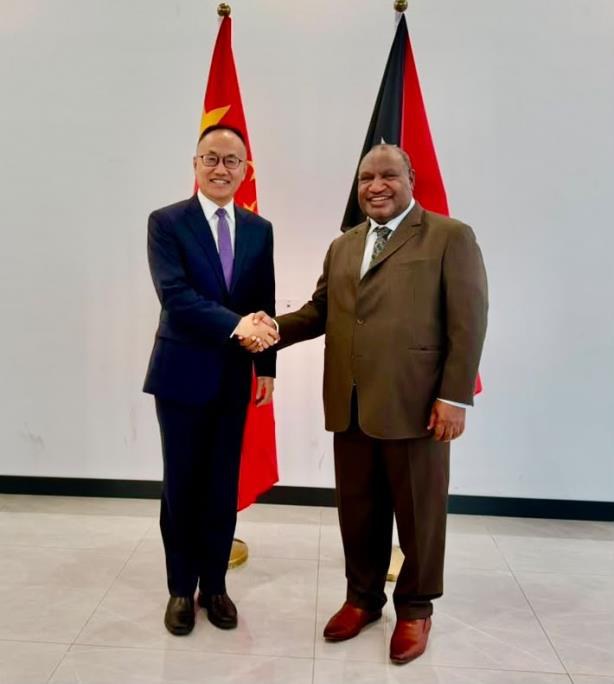
In Port Moresby, China International Development Cooperation Agency (CIDCA) Chairman Chen Xiaodong signed agreements worth an estimated US$11 million, and Prime Minister Marape asked for Mandarin in PNG schools. The day after Chen left, Taiwan announced it would close its office in PNG and end all aid. Chinese embassies in PNG and Tonga answered reports of a Chinese-made object, which PNG authorities identified as an artillery shell, with combative comments. New ambassadors in Fiji and Kiribati briefed ministers, editors, and the Chinese diaspora on the CCP’s Fifth Plenum. Embassy development programs delivered boats, grants, and supplies in the Solomon Islands, Tonga, and Kiribati.
(Source: PRC Embassy in PNG Facebook)
This Week’s Big Themes:
CIDCA’s Big Push in Port Moresby
From 3 to 5 November, China International Development Cooperation Agency (CIDCA, also known as China Aid) Chairman Chen Xiaodong visited Port Moresby. He met Prime Minister James Marape and National Planning Minister Sir Ano Pala. CIDCA and PNG’s Department of National Planning and Monitoring signed a memorandum of understanding (MoU) and two exchanges of notes covering nine projects. Finance Minister Thomas Opa put the new funding at K50 million (about US$11 million) in a Facebook post.
The nine projects span health, education, energy, telecommunications, and public spaces: a surgical center at Port Moresby General Hospital; redevelopment of Somare Park and Malalaua High School; a double-classroom extension at Malalaua; rehabilitation of the International Convention Center; a 15-megawatt solar plant in Hela; a household solar equipment program; an Adventure Park upgrade; and a concessional loan for the National Telekom Network.
The exchanges of notes appear to cover the two projects with stated values, the K5 million Malalaua extension and the K10 million Adventure Park upgrade, a combined K15 million (roughly US$3.3 million.)
The surgical center is the largest project, at an estimated K176 million (about US$30 million.) Opa’s post states a separate exchange of notes will formalize funding, which suggests grant aid. Opa’s K50 million figure, therefore, appears to exclude it. Two items reach PNG’s information infrastructure: the National Telekom Network loan, one of the nine projects, and further modernization of the state-run National Broadcasting Corporation’s digital television, which Chen listed as a priority.
The Prime Minister’s office said Marape told Chen that PNG “will never compromise” its One-China Policy. The readout also mentioned a forthcoming meeting between Marape and Xi Jinping, which Marape expects will focus on trade and investment. Marape asked for Mandarin as an optional subject for Grades 7 to 12, and Chen said Ambassador Yang Xiaoguang would follow up on the request. The two also discussed Bank of China commercial operations in PNG and reciprocal visa-on-arrival. Marape directed Treasury to vet any concessional loan against his goal of a balanced budget in 2027, and told Chen the government is strengthening its security arrangements to protect foreign business and encourage investment.
The payoff for China was immediate. On 6 November, the day after Chen’s visit ended, Taiwan’s Foreign Ministry announced it would close the Taipei Economic Office in Port Moresby following “recently renewed” demands from Papua New Guinea, which first announced the closure on 16 July. Taiwan stated it would withdraw its staff, and end “all technical cooperation and aid programs” in PNG. It also confirmed that it has ceased all spot-market purchases of liquefied natural gas from PNG. The ministry did not address long-term contracts.
Supporting Events
- Papua New Guinea: Marape Meets CIDCA Chairman Chen Xiaodong
- Papua New Guinea: CIDCA and DNPM Sign MoU and Exchanges of Notes
- Papua New Guinea: Opa: K5 Million Grant for Malalaua
- Papua New Guinea: PNGFacts: PNG Secures K5 Billion Chinese Portfolio
- Papua New Guinea: Taiwan Shuts PNG Office, Cuts All Aid
Artillery Shell, Wine Bottle, or Lucky Charm?
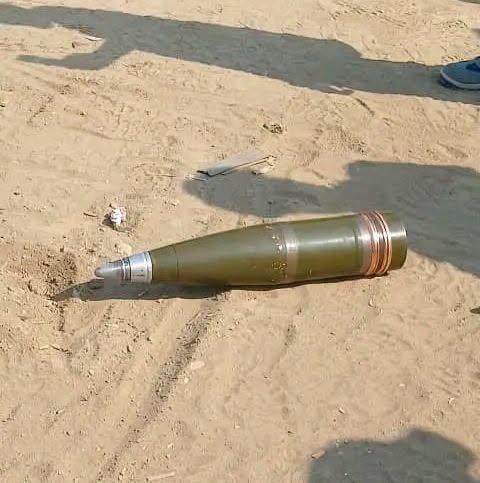
At the end of October, PNG seized a suspected artillery round from a commercial shipping container at a Port Moresby wharf on 29 October and arrested four Chinese nationals the next day. On 3 November, the Chinese Embassy in PNG posted that, “according to the company involved,” the object was “a shell-shaped wine bottle” that “poses no danger at all.” The same day, the Australian Broadcasting Corporation (ABC) reported that a police report identified the object as an undetonated 130mm Chinese Type 59 artillery projectile containing explosives and a fuse.
The embassy’s next statement dropped the wine bottle claim. It said the embassy “fully respects” the police’s position and offered a new explanation: some Chinese businessmen display “rendered-safe ordnance or ornaments” to “ward off evil spirits and bring good luck.” The explanation implies the object was real ordnance, but police reported explosives and a fuse inside it. The Chinese statement called the export of a single artillery shell from China “simply impossible” and warned “irrelevant parties” against smearing China. The Chinese Embassy in Tonga reposted the statement with its own line: “Facts are not defined by the third parties, even less by a diplomatic mission in Tonga.” The line appears aimed at the US Embassy in Tonga, though the Chinese embassy that posted it is also a diplomatic mission in Tonga. Within days, the embassy moved from denying the object was ordnance, to implying it was harmless ordnance, to attacking its critics.
Supporting Events
- Papua New Guinea: Embassy: Object Is a “Shell-Shaped Wine Bottle”
- Papua New Guinea: Embassy Responds to RPNGC Statement
- Tonga: Embassy Reposts PNG Statement, Rebukes “Third Parties”
- Papua New Guinea: ABC: Police Report Identifies Type 59 Projectile
Selling the Plenum
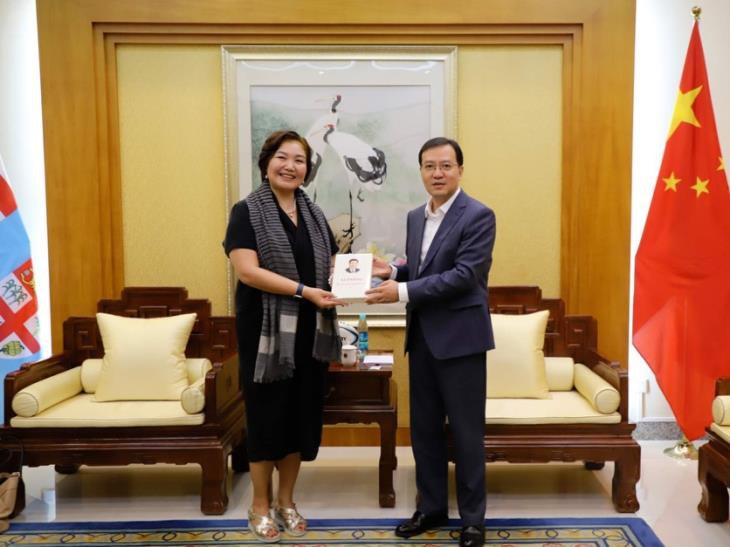
China’s ambassadors in Fiji, Kiribati, and Tonga briefed counterparts on the CCP’s Fifth Plenary Session in 12 of the 17 ambassador-level engagements recorded this week. The briefings repeated the same three points: the Party’s “full and rigorous self-governance,” Chinese modernization, and an offer to exchange “governance experience.”
Counterparts echoed the message. Kiribati Foreign Affairs Secretary Tearinaki Tanielu and Tobwaan Kiribati Party MP Betero Atanibora “highly commended” the Plenum’s outcomes. Vice President Teuea Toatu and Commerce Minister Tangariki Reete said Kiribati was ready to learn from China’s governance experience. Every Kiribati official briefed on the Plenum also reaffirmed the one-China principle. Tonga’s Acting Prime Minister Viliami Latu congratulated China on the Plenum’s “successful conclusion.” In Suva, UNDP Pacific Resident Representative Munkhtuya Altangerel expressed “admiration for China’s governance experience,” according to the embassy’s readout.
Ambassador Chen Haiping carried the message beyond government. At the Fiji Broadcasting Corporation and the Fiji Sun, he briefed editors and anchors on the Plenum and “the historical context of the Taiwan question,” and urged both outlets to uphold the one-China principle in their reporting. At the Chinese Association of Fiji, he relayed Xi Jinping’s “important expositions on overseas Chinese affairs” and urged the community to “support the great cause of national reunification of the ancestral homeland.” The week before, Chen had briefed the China Cultural Center in Fiji and the University of the South Pacific’s Confucius Institute. Within two weeks, the same message reached ministers, legislators, a UN official, two newsrooms, and an overseas Chinese association.
Ambassador Yao Fei’s other introductory calls this week included the Health Minister, the Acting Police Commissioner, the Minister of Culture and Internal Affairs, and a second Tobwaan Kiribati MP. The readouts provided no detail beyond “police cooperation” and “sub-national exchanges.”
Supporting Events
- Fiji: Chen Meets Tui Nayau Ratu Tevita Mara
- Fiji: Chen Calls on Foreign Affairs PS Solo Mara
- Fiji: Chen Meets UNDP Pacific Resident Representative
- Fiji: Chen Visits FBC and Fiji Sun
- Fiji: Chen Visits Chinese Association of Fiji
- Kiribati: Yao Meets Foreign Affairs Secretary Tanielu
- Kiribati: Yao Meets Commerce Minister Reete
- Kiribati: Yao Meets Tobwaan MP Atanibora
- Kiribati: Yao Meets Acting Police Commissioner Aritiera
* The PRC Pacific Embassies Monitor provides systematic, open-source tracking of Beijing’s public diplomatic activities across the nine Pacific Island Countries hosting Chinese missions. The monitor captures official embassy social media and website posts, supplemented by local sources, to offer a weekly structured intelligence report that bridges critical information gaps on regional engagement.