Fiji Sends Civil Servants to China’s Party School — Last Week in the Pacific
China’s Pacific ambassadors are missing—and the gap is not routine rotation. National Day receptions in Samoa, the Solomon Islands, Tonga, and Vanuatu were hosted by chargés d’affaires ad interim. Ambassadors host these events without exception in this monitor’s records. The absences extend well beyond National Day: across all four countries, ambassadors are absent from events where their presence would be standard: constituency handovers, ministerial meetings, and bilateral ceremonies. This absence is not a data artifact; these are events that should have an ambassador.
This monitor last recorded the Solomon Islands and Vanuatu ambassadors on 17 and 18 September, respectively. Ambassador Liu Weimin in Tonga last appeared on 2 September. Ambassador Fei Mingxing in Samoa addressed the National Day event by video but has not appeared in person since 7 September. None of the ambassadors are accompanying the high-level Pacific delegations currently touring China. None appear to be rotating out.
The pattern is most pronounced in Tonga and Samoa, where the gaps are the longest this monitor has recorded. Vanuatu shows the same pattern, if less sharply. No explanation has surfaced.
Summary of PRC Activity
Fiji’s military commander attended Beijing’s Xiangshan Forum, toured two of China’s largest arms manufacturers, and met a senior Central Military Commission official. Senior Fijian public servants and Solomon Islands university staff each completed China-hosted training courses tailored to their countries. In the Solomon Islands, the Chinese embassy engaged all nine provincial governments in a single week; two Chinese companies operating there illustrated opposite approaches to corporate presence in the Pacific.
(Source: SINU)
This Week’s Big Themes:
Training to Fit
China ran two training programs tailored to individual Pacific countries. From 1 to 12 September, 23 senior Fijian government officials attended the Senior Fiji Public Service Leadership Forum at the China Executive Leadership Academy Pudong (CELAP) in Shanghai—including, notably, two employees from the Fijian Bureau of Statistics. The bureau’s own readout highlighted exchanges on “effective leadership, organizational development and public sector transformation.”
The host institution’s primary role is training CCP cadres. The CCP’s Central Organization Department—the party body that controls personnel appointments across China—directly manages CELAP. Foreign programs run through a separate department but are still delivered by an institution whose primary role is producing officials loyal to a Leninist party.
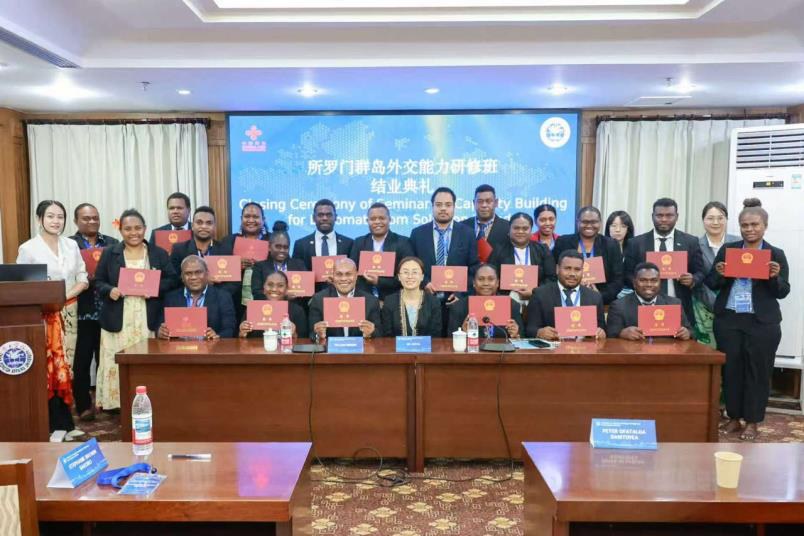
From 3 to 23 September, China Foreign Affairs University (CFAU)—the Ministry of Foreign Affairs’ training institution—taught diplomacy to the foreign service of a country it is actively courting, through a program designed for the Solomon Islands alone. It included lectures, professional skills sessions, field visits, and Chinese language classes. Five of the cohort’s members came from Solomon Islands National University, the institution that trains much of the country’s public service. Two other SINU staff members attended China’s Ministerial Workshop on Governance for Presidential Advisory Offices of Developing Countries from 15 to 24 September, covering institutional accountability, risk management, digital governance, and artificial intelligence.
Other training programs ran concurrently. Pohnpei’s Historic Preservation Office sent two staff members to a cultural heritage seminar designated for Belt and Road countries. In Kiribati, fisheries officials attended ocean modeling and governance courses run by institutes under China’s Ministry of Natural Resources.
Supporting Events
- Fiji: FBoS Officials Attend CELAP Leadership Forum
- Solomon Islands: SINU Staff Attend CFAU Capacity-Building Seminar
- Solomon Islands: SINU Staff Attend Governance Training in China
- Federated States of Micronesia: Pohnpei HPO Attends Belt and Road Heritage Seminar
- Kiribati: MFOR Staff Attend Ocean Training Courses
Fiji’s Commander in Beijing
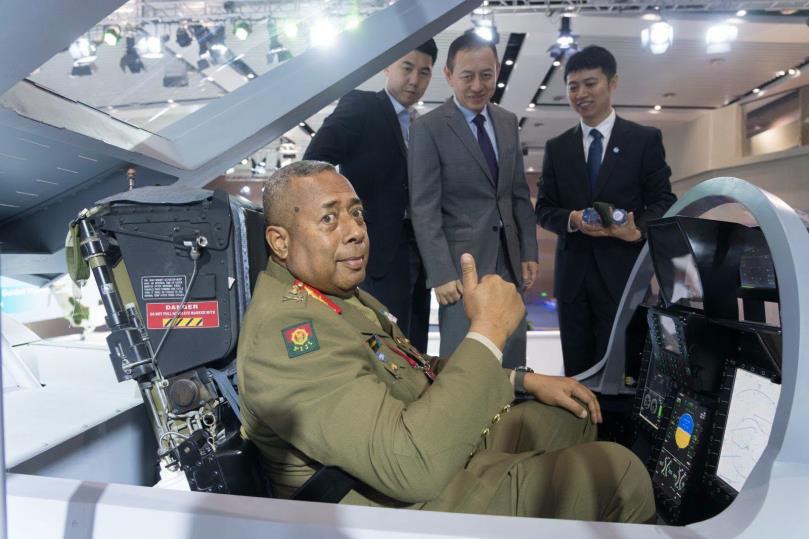
Republic of Fiji Military Forces (RFMF) Commander Major General Ro Jone Kalouniwai attended the 13th Beijing Xiangshan Forum—China’s annual intergovernmental security conference—from 15 to 17 September at Beijing’s invitation. The RFMF used the forum to reinforce its Ocean of Peace concept, “stressing dialogue, respect for sovereignty, and practical cooperation guided by Pacific priorities.”
Senior Colonel Zhang Yu, China’s defense attaché to Fiji, accompanied the General on visits to two Chinese defense firms. At China Aero-Technology Import & Export Corporation (CATIC), the delegation received briefings on defense aviation and field deployment technologies; both sides discussed capability development cooperation, “including humanitarian assistance and disaster response (HADR) and peacekeeping operations (PKO).” At China North Industries Group, the company briefed the delegation on China’s defense manufacturing capacity.
On 16 September, Kalouniwai met Major General Ye Jiang, Deputy Director of the Central Military Commission’s International Military Cooperation Office. Kalouniwai thanked China for cooperation that has included “professional military education, equipment assistance, peacekeeping support, senior-level exchanges and humanitarian initiatives.” Both sides discussed new opportunities, notably including at Blackrock Camp—an Australia-funded peacekeeping and disaster response center near Nadi—which Kalouniwai invited the Chinese delegation to visit. The RFMF readout also notes Kalouniwai’s request for “timely updates and regular coordination on existing requests and areas of assistance”—perhaps an indirect reference to China’s last-minute notification of the August missile launch.
Supporting Events
Subnational Engagement in the Solomons
On 30 September, Chargé d’Affaires Yang Jie met representatives of all nine Solomon Islands provinces—including at least five provincial premiers—to discuss subnational cooperation. Earlier that week, Yang presented SBD 150,000 (about US$18,900) to 37 SINU recipients of the Chinese Ambassadors Scholarship. Two Chinese companies illustrated opposite models of corporate engagement in the Pacific.
* The PRC Pacific Embassies Monitor provides systematic, open-source tracking of Beijing’s public diplomatic activities across the nine Pacific Island Countries hosting Chinese missions. The monitor captures official embassy social media and website posts, supplemented by local sources, to offer a weekly structured intelligence report that bridges critical information gaps on regional engagement.