Guangdong and its Capital Send Delegations to the Pacific — Last Week in the Pacific
An SBD 100,000 (roughly US$12,000) PRC-funded lighting project for the Anglican Diocese of Guadalcanal surfaced last week—25 security lights installed at the Diocesan headquarters and Good Shepherd Church at Foxwood, North Guadalcanal.
North Guadalcanal MP Dr. Paul Popora Bosawai arranged the project with the embassy. Diocesan Bishop Benedict Loe thanked the Chinese government.
Churches are the most pervasive social institution in the Pacific Islands and the one space where an officially atheist state has the least natural standing. Lighting a diocesan compound costs the embassy almost nothing and buys presence in a space Western partners have occupied by default—without putting a Chinese diplomat inside a church.
Summary of PRC Activity
Governors and senior economic officials from all four FSM states traveled to China for a Ministry of Commerce seminar organized by a Zhejiang body that doubles as China’s BRICS special economic zones secretariat. A Guangzhou municipal delegation broke ground on a Chinese-funded public square in Naoero and signed two agreements, while a Guangdong provincial delegation arrived in Fiji. In Honiara, Ambassador Cai Weiming handed over reconstructed public buildings damaged in the 2021 unrest; the embassy also funded projects across three constituencies.
(Source: The Government of Naoero)
This Week’s Big Themes:
One Province, Two Capitals
A six-person delegation from the Guangzhou Municipal Government led by Chen Xiongqiao, Vice Chair of the Standing Committee of the Municipal People’s Congress, arrived in Naoero on 15 September. Deputy Speaker Isabella Dageago received the group at Parliament, where Chen framed the visit as building on a similar delegation last year.
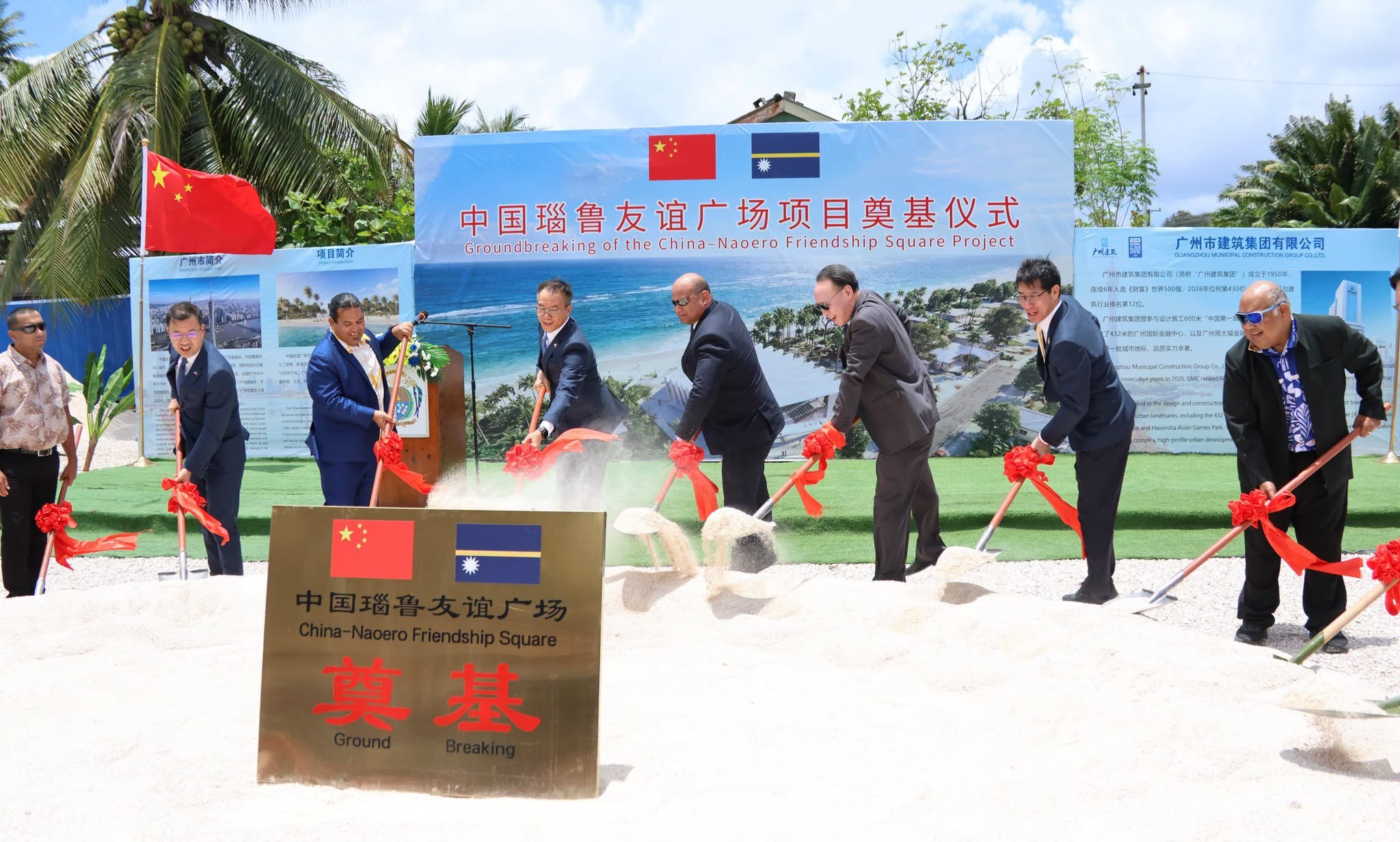
The delegation then broke ground on the China-Naoero Friendship Square in Nibok—a 3,200 square meter Guangzhou-funded development with a basketball court, commercial space, and pillars carrying the symbols of Naoero’s 12 tribes, to be built by a Guangzhou company. Deputy Minister Ranin Akua and Chen signed agreements: one on project cooperation and one establishing friendly relations between Naoero and the Municipality of Guangzhou. With the delegation in town, the embassy held an early National Day reception—more than two weeks before 1 October. Ambassador Lyu Jin, Vice Chairman Chen Xiongqiao, and Minister Charmaine Scotty delivered remarks; dei-Naoero and Guangdong performers followed.
A separate Guangdong Provincial Government delegation spent the week in Fiji. Vice Governor Zhang Guozhi met Foreign Minister Sakiasi Ditoka on 14 September; Ditoka reaffirmed Fiji’s one-China policy. The agenda covered the roughly US$130 million China Aid Vanua Levu road upgrade alongside technical training, small-scale renewables for the outer islands, market access for kava, coconut, fisheries, and mineral water. The delegation donated 100 solar streetlights and opened the 2026 Guangdong Products Roadshow at Suva’s Grand Pacific Hotel, the sixth Pacific roadshow the China Council for the Promotion of International Trade’s Guangdong committee has run since 2016. Deputy Prime Minister Manoa Kamikamica opened the event.
This monitor has tracked Guangdong provincial engagement in all nine Pacific countries hosting Chinese missions. Guangdong’s ties run deepest with Papua New Guinea—where Xi Jinping offered in April to make Guangdong PNG’s primary Chinese partner—and Naoero, whose president David Adeang has led multiple delegations to the province and whose family traces roots to Guangdong.
Supporting Events
- Nauru: Guangzhou Delegation Visits Parliament
- Nauru: Friendship Square Groundbreaking
- Nauru: MoU Signings with Guangzhou
- Nauru: 77th Anniversary Reception
- Fiji: Guangdong Vice Governor Meets Foreign Minister Ditoka
- Fiji: Guangdong Products Roadshow Opens in Suva
- Fiji: Guangdong Donates 100 Solar Streetlights
Dual Tracks in the Solomons
On 17 September, Ambassador Cai Weiming handed over reconstructed public facilities in Honiara at a ceremony attended by Finance Minister Rexon Ramofafia, Education Minister Stephen Kumi, the Honiara mayor, and more than 300 guests. The project covered the parliament’s ceremonial building and a secondary school damaged in the 2021 unrest. Cai called the result a symbol of bilateral friendship and praised the government’s adherence to the one-China principle. The unrest that destroyed these buildings followed the 2019 recognition switch to Beijing; China has now rebuilt them.
The embassy’s routine constituency spending appeared across three separate electorates the same week. Lau and Baelelea MP Ben Maenu’u received SBD 100,000 (roughly US$12,000) from the embassy, directed the full amount to street and solar lights, and oversaw their handover on 11 September. Counsellor Gu Wenlong publicly praised Maenu’u for the speed of distribution—a Chinese diplomat on record commending a Solomon Islands MP for how he spends Chinese money. Finance Minister and Fataleka MP Rexon Ramofafia—who had attended the parliamentary handover earlier that week as a cabinet minister—separately thanked the embassy for five paddling canoes and outboard motors delivered to his constituency. The embassy also donated 100 tents and 500 solar lights through the China-Pacific Island Countries Reserve of Emergency Supplies, using the announcement to tally its disaster relief spending for the year: the US$1 million pledged during Foreign Minister Hou’s July visit to Beijing, SBD 500,000 to the National Disaster Management Office, 40 outboard motors to Western Province, and SBD 359,000 from the Red Cross Society of China.
The Reserve connects to the week’s Guangdong thread. One of the seven China-Pacific Island Countries multilateral platforms, it is headquartered in Guangzhou and administered by Guangdong provincial agencies.
Supporting Events
- Solomon Islands: Capital Public Facilities Reconstruction Handover
- Solomon Islands: Lau Baelelea Lighting Handover
- Solomon Islands: Fataleka Fishery Mini-Project
- Solomon Islands: Emergency Supplies Donation
Four States, One Seminar
Pohnpei Governor Stevenson A. Joseph led a delegation to China last week alongside counterparts from Kosrae, Yap, and Chuuk. The Pohnpei release described the trip as a joint mission focused on direct foreign investment, trade expansion, and economic development. Photographs from the trip reveal more information: the banner depicts a seminar sponsored by China’s Ministry of Commerce and organized by the Zhejiang Provincial Free Trade Development Center. The agenda names the event the “Seminar for Trade Promotion for the Federated States of Micronesia.”
That organizer is the detail worth holding. The Center is a public institution under the Zhejiang Provincial Department of Commerce with an explicit foreign-aid training mandate. It also serves as Secretariat of the BRICS Special Economic Zones China Cooperation Center. The office running economic development training for FSM’s four state governments is the same body China built to export its special economic zone model to its close economic partners.
In Hangzhou, Pohnpei Governor Joseph met Executive Vice Governor Xu Wenguang. Xu described the meeting as deepening friendship and offered concrete support—including further training delegations to Pohnpei and assistance with solar energy. On Pohnpei’s request for a vessel to serve its outer islands, Xu responded favorably and said the matter would move through diplomatic channels. His offer on the training side carried no ceiling: “There is no limit on the list,” he said. The meeting also reactivated the 1997 Pohnpei–Zhejiang sister-state MOU—signed under Governor Pangelinan and dormant since—which Joseph described as having had no follow-up until now.
The delegation’s composition points the same direction as the seminar’s organizer. Beyond the state’s executives, the roster includes Mark Kostka, Director of Pohnpei’s Department of Resources and Development; Peterson Sam, Commissioner at the Pohnpei Public Broadcasting Corporation and President of the Pohnpei Export Association; Henry Saimon Jr., Executive Director of the Pohnpei State Housing Authority; and Shirley Ligohr, FSM’s Overseas Development Assistance Coordinator. Pohnpei’s delegation also included Chief of Staff Patterson K. Shed and Jorg Anson, administrator of the Office of Fisheries and Aquaculture. One national-level official attended: Kalvin Ehmes, deputy assistant secretary of the FSM Department of Foreign Affairs. His presence complicates the picture slightly—but a deputy assistant secretary is not a counterpart to a state governor, and his attendance does not change who controls the permitting, land, and siting decisions a zone-type project would require.
Under the FSM constitution, foreign affairs belongs to Palikir, but land, permitting, and most of the machinery a zone-type project would need belong to the states. A MOFCOM seminar that convenes the economic officials of all four states—and reactivates a dormant sister-state relationship in the margins—puts Beijing in a room with the people who control siting, and does so with only a deputy-level national counterpart in the frame.
Supporting Events
- Federated States of Micronesia: Four States Send Joint Delegation to China
- Federated States of Micronesia: Pohnpei State Press Release
* The PRC Pacific Embassies Monitor provides systematic, open-source tracking of Beijing’s public diplomatic activities across the nine Pacific Island Countries hosting Chinese missions. The monitor captures official embassy social media and website posts, supplemented by local sources, to offer a weekly structured intelligence report that bridges critical information gaps on regional engagement.