Qian Bo Brings a Ledger to a Check Fight — Last Week in the Pacific
On 2 September, China’s Ministry of Emergency Management and the Tonga Fire and Emergency Services (TFES) signed a memorandum of understanding (MoU) on fire safety cooperation.
Ambassador Liu Weimin and TFES Commissioner Viliami Tu’ihalamaka signed at TFES headquarters; Minister Viliami Latu witnessed.
The MoU covers fire safety governance, capacity building, equipment, infrastructure support, joint exercises, and international rescue operations.
Ministry of Emergency Management Director-General Fan Zhaohui led the delegation and remained in Tonga to tour fire stations and disaster-affected communities.
The agreement formalizes a relationship already in motion. Five Tongan fire officers attended a Chinese course on climate change and disaster risk management in July.
Summary of PRC Activity
China’s Special Envoy Qian Bo attended the Pacific Islands Forum Leaders Meeting (PIFLM), where Taiwan’s presence drew more attention than any Chinese deliverable. Outside the forum, China had a busy week: multiple donations across Kiribati and the third drone-related event in Vanuatu in as many weeks.
(Source: Embajada de Cuba en Fiyi)
This Week’s Big Themes:
What Beijing Actually Brought to Koror
Qian Bo’s objection to Taiwanese Foreign Minister Lin Chia-lung’s attendance at the PIFLM—and his threat of “consequences”—drew the week’s coverage. But the threat was not Qian’s only move in Koror.
Qian delivered a speech at the Leaders Dialogue built almost entirely on past achievements: 10 completed projects, four in progress, seven medical teams deployed since last year, seven China-PICs multilateral platforms, and 16,000 patients treated aboard the hospital ship Silk Road Ark. The speech’s commitments are ambitious: increased renewable energy support, a China-PICs Blue Partnership, expanded trade and investment, and a continued US$200,000 donation to the Secretariat of the Pacific Regional Environment Programme this year—it is unclear if this is a new commitment or the same sum Beijing already provided in January 2026.
Qian’s closing remarks played on Australia’s Pacific family: “As an ancient Chinese proverb goes, ‘A just cause finds many supporters, and we are all one family under the sun.’”
Where Qian’s catalogued past work, US Deputy Secretary of State Landau announced US$150 million in new commitments. Separately, Australia pledged roughly US$430 million over ten years to Waqa Moana, a Pacific based initiative to combat the increasing regional drug trade.
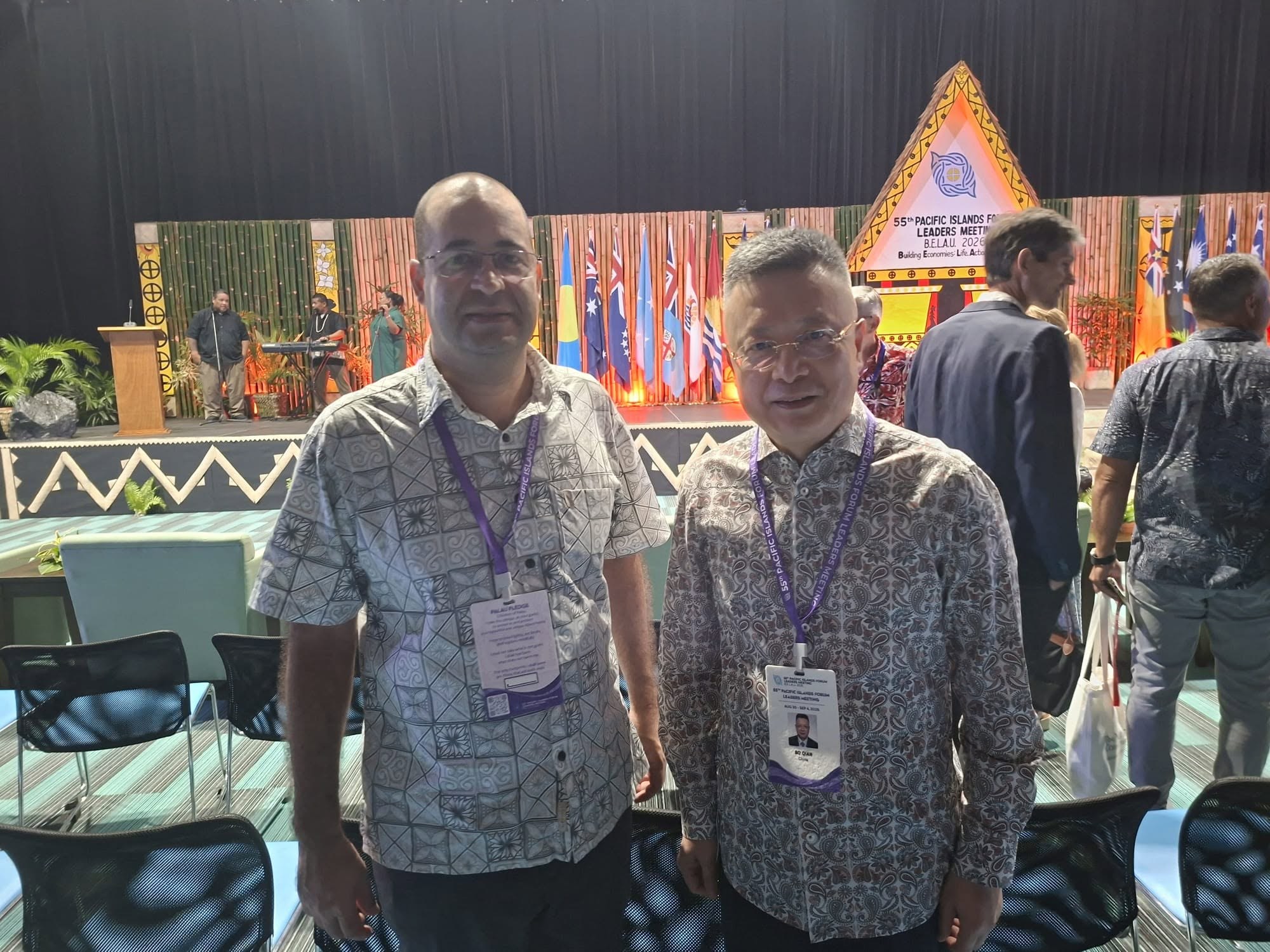
Away from the main stage, Qian held a series of high-level, bilateral meetings. He met Tongan Prime Minister Lord Fakafanua, Papua New Guinean Prime Minister James Marape, Naoero President David Adeang, and Cook Islands Prime Minister Mark Brown. Qian also spoke with Cuban Ambassador Néstor Torres Olivera at the opening ceremony—the fourth contact between Chinese and Cuban diplomats in the region this monitor has recorded this year. Marape reaffirmed the one-China policy; Qian expressed China’s commitment to increasing LNG purchases and downstream investment.
Naoero President Adeang arrived late and moved quickly. Qian’s meeting came second—Adeang met first with James Hsu, the US Assistant Director of the East Asia Pacific Mission Center, and followed up with Deputy Secretary Landau later in the week.
Qian’s meeting with Brown followed late August’s delivery of the MV Tuitui Moana, an inter-island ship built in China and co-funded by the both governments for US$3 million. Brown affirmed his country’s one-China policy. In comparison, the United States, New Zealand, and Cook Islands announced a US$60 million port investment at Penrhyn—US$50 million from Washington, the remainder from Wellington.
This monitor found no record of a PIFLM meeting between Qian and FSM leadership, but Qian met FSM Congress Speaker Esmond B. Moses on 25 August in Beijing. Qian briefed Moses’ delegation on the 15th Five-Year Plan and, per the readout, “the successful experience of the Communist Party of China in governance.” Chairman of the China International Development Cooperation Agency Chen Xiaodong received the same delegation three days later.
Supporting Events
- China: Qian Bo Remarks to the PIF Leaders Dialogue
- Tonga: Qian Bo Meets PM Lord Fakafanua
- Papua New Guinea: Marape Meets Qian Bo
- Nauru: Adeang Meets Qian Bo
- Nauru: Adeang Meets Deputy Secretary Landau
- Cook Islands: Qian Bo Meets Cook Islands PM Mark Brown
- Cuba: Cuban Ambassador Greets Qian Bo at Opening Ceremony
- Federated States of Micronesia: Speaker Moses Meets Qian Bo
- Federated States of Micronesia: Speaker Moses Meets CIDCA
Kiribati’s Embassy Finds Its Voice
While Kiribati’s delegation attended the PIFLM in Koror without President Maamau, China’s embassy in Tarawa publicized five events—as many as in the preceding five weeks combined. The week’s activity centered on material donations across the country. Chargé d’Affaires Zhao Jian and Minister for Line and Phoenix Islands Development Mikarite Temari attended a handover ceremony for a 16-seat minibus for Kiritimati. The embassy donated three trucks to Abemama Island. All bore China Aid branding. The Abemama readout also included a photograph of an embassy official handing a check to Minister Tokaibure Rabaua.
The embassy also donated US$660 to support food delivery to Betio residents displaced during an unexploded ordnance clearance New Zealand led—attaching Beijing’s name to another partner’s project at a cost equivalent to a rounding error.
President Maamau’s absence from Koror had a counterpart at home; on 3 September, he cut the ribbon for the completed Tungaru Central Hospital emergency ward expansion, built by China Railway First Group. He skipped the regional forum; he showed up for the Chinese infrastructure.
Supporting Events
- Kiribati: Minibus Handover for Kiritimati
- Kiribati: Truck Donation to Abemama
- Kiribati: Funding for Betio UXO Clearance Relocation
- Kiribati: TCH Emergency Ward Expansion Completion
Chinese Drones and NGO Training for Vanuatu
Over three weeks, Chinese officials and organizations delivered drone hardware and training to three separate arms of the Vanuatu government: correctional services, provincial police, and health officials.
On 14 August, the Chinese embassy donated drones to Vanuatu Correctional Services and the Chinese Police Expert Team trained 10 correctional officers from Port Vila, Santo, and Tanna. The embassy stated the drones would enable aerial patrols “enabling real-time, full-coverage aerial surveillance and enhancing three-dimensional dynamic management capabilities.”
From 26 to 27 August, the police team traveled to Tanna to train nearly 20 Tafea provincial officers in arrest techniques, vehicle checks, personal searches, drone operations, and body-worn camera use.
Last week, the GX Foundation and DJI—the world’s largest drone manufacturer—ran a five-day drone course for Vanuatu government and health officials. The training follows the MoU signed in July by GX Foundation Chairman Leung Chun-ying, who also serves as Vice-Chairman of the National Committee of the Chinese People’s Political Consultative Conference, as well as Vanuatu’s Minister of Health.
Deputy Speaker Paul Paolo and MP Alan Liki attended the China NGO Network for International Exchanges (CNIE)-hosted Asia-Pacific Civil Society Conference in Jinan last week. Paolo affirmed Vanuatu’s readiness to expand people-to-people exchanges with Chinese civil society organizations. China’s NGO sector operates under CCP control—a model Beijing now exports through forums like this one.
Supporting Events
- Vanuatu: Drone Donation and Training for Correctional Services
- Vanuatu: Police Expert Team Trains Tafea Officers on Tanna
- Vanuatu: GX Foundation and DJI Drone Training
- Vanuatu: Deputy Speaker Attends Jinan Civil Society Conference
* The PRC Pacific Embassies Monitor provides systematic, open-source tracking of Beijing’s public diplomatic activities across the nine Pacific Island Countries hosting Chinese missions. The monitor captures official embassy social media and website posts, supplemented by local sources, to offer a weekly structured intelligence report that bridges critical information gaps on regional engagement.