China Addresses Taiwan Holdouts — Last Week in the Pacific
On 31 July, China handed over the Solomon Islands National Broadband Infrastructure Project: 161 telecommunications towers built by China Harbour Engineering Company (CHEC) using Huawei equipment and financed by China Exim Bank.
Ambassador Cai Weiming and Communications Minister Fredrick Kologeto attended the ceremony at Tenaru School.
Ownership passes to Solomon Tower Limited, but CHEC Managing Director Chen Wei framed the handover as “a new starting point,” pledging warranty coordination, fault response, and ongoing operations and maintenance support, with Huawei remaining involved alongside CHEC.
The towers change hands; the technical relationship does not. The project ranks among the largest completed Chinese infrastructure projects this monitor has tracked in the Solomon Islands.
Summary of PRC Activity
Chinese diplomats published opinion pieces in the local press across three countries. In Fiji and the Federated States of Micronesia, Wang Yuan and Wu Wei each made the case for the one-China principle, using Papua New Guinea’s closure of the Taipei Economic Office as their opening argument. In Tonga, Liu Weimin defended China’s recent missile test. In the Solomon Islands, China completed and handed over a broadband infrastructure project.
This Week’s Big Themes:
Working the PNG Closure
Chargé d’Affaires Wang Yuan published in The Fiji Sun on 25 July; Ambassador Wu Wei published in the FSM’s Kaselehlie Press on 28 July. Both officials lead with the same core line: China’s position on Taiwan is an undeniable truth, and other countries’ acceptance of it is inevitable. Both authors recite the principle’s three core elements, cite UN General Assembly Resolution 2758, count 183 committed countries, invoke the “four full respects,” and name the Solomon Islands, Kiribati, and Naoero (formerly Nauru) as the region’s countries that recently switched recognition.
Beneath the shared boilerplate, the two essays differ in style and target.
Wang’s article traced the historical record: Japan’s 1895 seizure of Taiwan, the Cairo Declaration, the Potsdam Proclamation, the October 1945 resumption of sovereignty, and the surrender ceremony in Taipei. He then turned to Fiji, quoting the 1975 joint communiqué and Prime Minister Rabuka’s reaffirmation in the 2024 China–Fiji Joint Statement. Wang praised the 2017 closure of Fiji’s trade office in Taipei and the 2019 renaming of the Taipei Trade Office in Fiji and revocation of its diplomatic privileges.
The structure makes the argument without stating it: Wang opened on PNG closing its trade office, then cataloged Fiji’s own record of narrowing Taipei’s presence. The implication is clear: Fiji should close the Taipei Trade Office in Fiji. Reunification is an historical inevitability, and Fiji should work towards making it a reality.
Wu Wei’s article is aimed at the broader region rather than his immediate host country. Wu singled out the Marshall Islands, Palau, and Tuvalu for their continued recognition of Taiwan, and notably directed blame not at the Taiwanese state but at the Democratic Progressive Party (DPP), which he accused of coercing Pacific Island countries. This framing likely reflects the KMT Chairwoman’s trip to Beijing last April, suggesting a coordinated effort to distinguish the DPP from Taiwan as a whole.
Wu contrasted the DPP’s alleged bribery and dollar diplomacy with China’s ‘principled approach,’ citing Chinese tourist arrivals in Palau and the benefits of the Belt and Road Initiative as evidence of holistic economic benefit. The bribery charge is whataboutism—China uses the same tools. Wu also omits the reality of Chinese tourism in Palau: Beijing has weaponized tourist flows against Palau, damaging its economy and environment.
Wu’s closing addresses the people of Palau and the Marshall Islands directly: he called on them to “encourage their governments to recognize the trend, leap from the sinking broken ship of ‘Taiwan independence’ separatist forces in time and make the right choice that accords with the trend of the times.”
Chinese ambassadors frequently publish pieces urging adherence to Beijing’s one-China principle. Wu Wei ran a version of this article last December. What distinguishes this one is the audience: Wu is addressing publics in countries where China has no diplomatic representation. Without a mission in Palau or the Marshall Islands, China runs its official messaging through its FSM embassy.
Supporting Events
- Fiji: Wang Yuan Published in Local Press on One-China Principle
- FSM: Wu Wei Published in Local Press on One-China Principle
Liu Weimin Defends the Missile Test
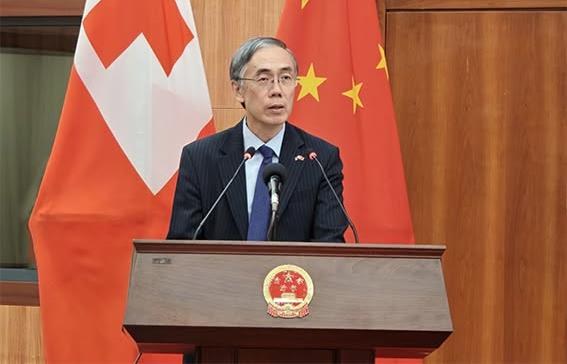
While the region’s other ambassadors wrote about Taiwan last week, China’s Ambassador to Tonga Liu Weimin published an article entitled “China’s Role in Peace and Security in the Pacific and China-Pacific Island Countries Cooperation,” timed to the PLA’s 99th founding anniversary on 1 August and used in part to defend China’s early July missile test.
Most of the essay covers PLA history: the Long March, 50,000 peacekeepers across 29 UN missions, and the PLA’s origins among the people. Liu also adds Tonga-specific material, such as the PLA Navy relief effort after the 2022 eruption and tsunami, the 2024 International Fleet Review marking King Tupou VI’s 65th birthday, and port calls by the Peace Ark and Silk Road Ark.
Liu argued that the missile test maintained the reliability of China’s strategic deterrence, had no connection to nuclear testing, and targeted no country or region. He called on observers to avoid over-interpretation or double standards, framing criticism of the test as a failure of perspective rather than legitimate concern.
On regional alignment, Liu argued against spheres of influence and discriminatory or exclusive arrangements. The language likely targets the Ocean of Peace Alliance that Australia and Fiji signed last month.
Days after publication, Liu visited the China-funded Armed Forces Music Center at Taliai Camp, describing it as two militaries drawing closer.
Supporting Events
* The PRC Pacific Embassies Monitor provides systematic, open-source tracking of Beijing’s public diplomatic activities across the nine Pacific Island Countries hosting Chinese missions. The monitor captures official embassy social media and website posts, supplemented by local sources, to offer a weekly structured intelligence report that bridges critical information gaps on regional engagement.